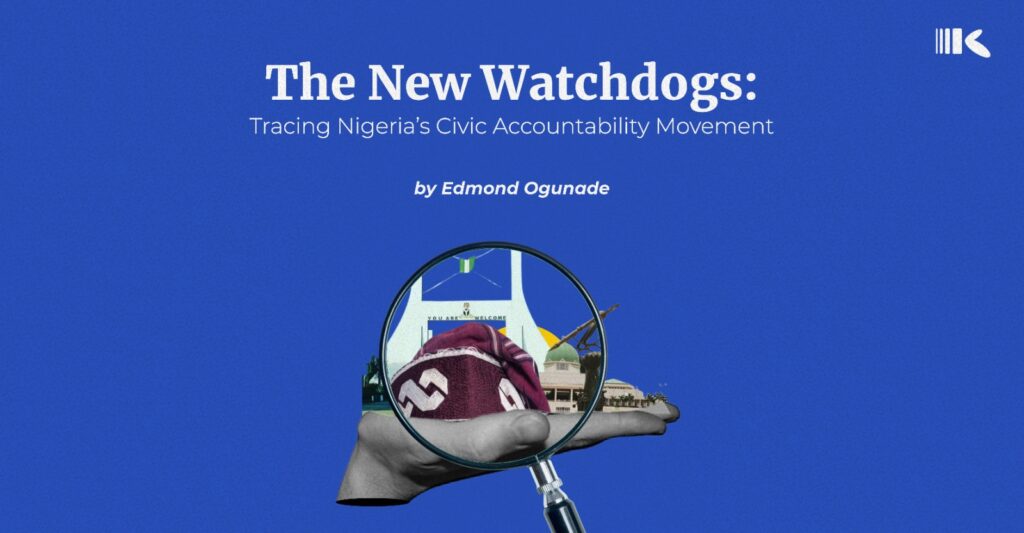
When you hear the word watchdog, what comes to mind? Maybe journalists chasing politicians through the corridors of power, or activists holding placards at the National Assembly. This was the case in the 1990s and early 2000s, where organisations like the Civil Liberties Organisation (CLO) and the Transition Monitoring Group (TMG) led the charge for human rights, election integrity, and government transparency. But these days, Nigeria’s real watchdogs aren’t only on the streets. This is a new era of civic-tech and accountability organisations, where a new generation of changemakers are using technology to strengthen democracy. Names like BudgIT, Civic Hive, Connected Development (CODE), and YIAGA Africa have become familiar to anyone following Nigeria’s governance and transparency space.To understand how they came to be, let’s meet some of the pioneers shaping this new movement.
YIAGA Africa: Mobilising a Generation for Democracy
Founded by Samson Itodo in 2007, YIAGA began as a youth-led movement on university campuses, promoting civic participation and political education at a time when young Nigerians were largely disengaged from politics.
Over the years, YIAGA Africa evolved into one of the country’s most trusted voices on election monitoring, governance reform, and youth inclusion. Its groundbreaking #NotTooYoungToRun campaign became a national movement that successfully pushed for a constitutional amendment lowering the age limit for elective offices. That single reform changed Nigeria’s political landscape, opening doors for a new generation of leaders.
YIAGA Africa also runs Watching the Vote (WTV), one of the most credible citizen-led election observation projects in West Africa. Using data and technology, WTV has deployed thousands of observers to polling units across Nigeria, providing independent analysis of elections and ensuring that votes truly count. During the 2019 and 2023 general elections, their real-time reporting and parallel vote tabulation helped verify official results and strengthen public trust in the process.
Beyond elections, YIAGA Africa works on legislative engagement and civic education with the intention to help citizens understand how laws are made, how to hold representatives accountable, and how to build lasting democratic institutions.
BudgIT: Turning Budgets Into Stories
The story of BudgIT began in 2011 when two young innovators, Oluseun Onigbinde and Joseph Agunbiade, joined a hackathon at Co-Creation Hub (CcHub) in Lagos. Their goal was to make Nigeria’s federal budget understandable to everyday citizens. What started as a small tech experiment quickly grew into one of Africa’s most influential civic tech organisations.
BudgIT transformed long, confusing government documents into clear, visual infographics that anyone could read and question. For the first time, Nigerians could trace how public funds were allocated and where the money really went. The platform’s popularity soared, especially during the 2012 Occupy Nigeria protests, when BudgIT’s budget breakdowns went viral online.
BudgIT’s work soon attracted major global funders, including the Omidyar Network, Ford Foundation, MacArthur Foundation, and Bill & Melinda Gates Foundation, allowing it to scale operations and expand across several African countries. Through initiatives like State of States, #FixOurOil, and PHCTracka, the organisation has pushed for fiscal transparency, responsible spending, and better governance at both federal and state levels.
More than a decade later, BudgIT has changed the way Nigerians see governance. It has turned data into stories and helped citizens understand that accountability is a right.
Civic Hive: Nurturing Civic Innovation
Civic Hive was founded in 2017 as the innovation arm of BudgIT, designed to be a space where civic tech ideas, media teams, and NGOs could collaborate.
Through its 20-week incubation and implementation program (“CivicTech Fellowship’), Civic Hive supports early-stage civic innovations. The fellowship is open to ideas in areas like transparency, civic participation, justice reform, institutional efficiency, and accountability. Over time, Civic Hive has incubated 24 civic start-ups and supported over 107 organizations across Nigeria It also provides training to NGOs and media groups in data storytelling, design, communications and digital tools.
One of its notable products is Gavel, a justice tech tool for promoting transparency, accountability, and faster legal recourse. Gavel was developed under Civic Hive’s incubation and has grown into a standalone civic tech entity. Civic Hive also launched LGAlert, which allows citizens to query local government allocations via USSD to track how much money their local governments receive.
Follow The Money: Accountability in Action
While BudgIT focused on public finance, another organisation took the message to the grassroots. Founded in 2012 by Hamzat Lawal, CODE was born after a government had announced millions for a health project in a rural Nigerian community, but when Hamzat visited, nothing was on the ground.
Through its flagship initiative, Follow The Money, CODE began tracking how public funds are used (or misused) in local communities. The idea was simple: if the government claims to have built a school, dug a borehole, or supplied healthcare equipment, citizens should be able to see it. And if it doesn’t exist, they should speak up.
Armed with data and smartphones, CODE’s team and volunteers travel across states, collecting photos, testimonies, and evidence. These findings are then published online, drawing media attention and public pressure that often forces officials to act. Over time, this blend of data-driven advocacy and community mobilisation has led to the completion or revival of hundreds of projects that would otherwise have been abandoned.
Beyond Nigeria, Follow The Money has expanded its model to other African countries including The Gambia, Kenya, and Malawi. CODE has also partnered with major international organisations like the United Nations, Oxfam, and the MacArthur Foundation, amplifying its impact through training, open data tools, and policy advocacy.
Why These Organisations Matter
Nigeria’s democracy has always struggled with access to information. Government processes are often opaque, budgets are complex, and accountability is slow. Civic-tech organisations are closing those gaps.
They simplify information so people can understand it. They use data to back up advocacy with facts instead of emotions. They make it possible for citizens to question leaders with evidence in hand. And they help create a feedback loop between citizens and government that keeps democracy alive between elections.
The rise of these organisations has redefined the relationship between citizens and the state. For the first time in Nigeria’s democratic history, governance is becoming a two-way conversation. Access to information has empowered citizens to hold leaders accountable in ways that were once impossible. Budgets, project reports, and election results that used to sit in dusty government folders now live online, open for scrutiny. This visibility has created a new sense of ownership among Nigerians, a sense of shared responsibility.
The effect of this might appear subtle yet it is profound. Public officials are more cautious with public statements. Legislators know that citizens are watching and fact-checking in real time. Journalists have better data to work with, and civil society collaborations are stronger and more coordinated than ever. Most importantly, these organisations are rebuilding public trust by proving that accountability is possible.
Conclusion- A New Kind of Citizenship
The story of Nigeria’s civic accountability movement is, at its core, a story of reinvention. From the days of street protests and handwritten petitions, the country has moved into an era where a few lines of code or a well-visualised dataset can spark nationwide conversations about governance.
These organisations are bridge-builders who are connecting citizens to the institutions that shape their lives. Their work proves that democracy thrives not only on votes, but on vigilance, participation, and access to truth. Challenges remain but the direction is clear, and now a new generation of Nigerians is learning that accountability is a civic duty.
So, when the next budget leak trends online, or a stalled public project suddenly restarts after public scrutiny, we should recognise what’s happening.
The new watchdogs are at work.