
You have likely come across content creators who mock patronising questions about Africa’s access to electricity, clothing, or housing.
Or seen satirical takes on how global media reports on the continent.
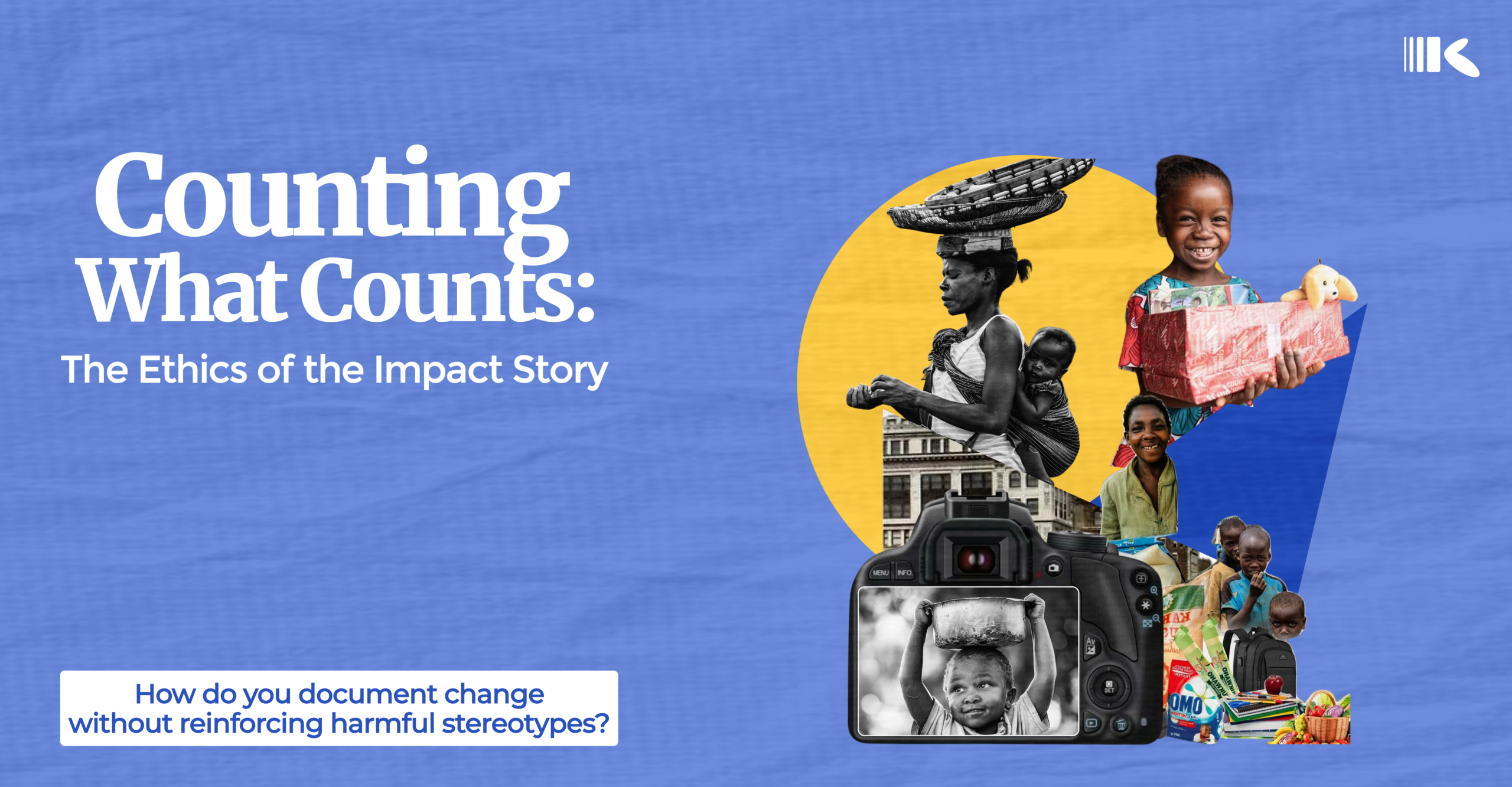
Or, more commonly, fundraising materials built around images of visibly distressed children.
Across these, a pattern emerges. Africa is framed through lack.
Why does this persist? Because the narrative was recorded that way, and over time, it has been repeated, adopted, and reinforced, often without interrogation.
What is ethical impact storytelling?
In social impact work, storytelling serves a purpose. It supports advocacy, funding, and visibility.
Ethical impact storytelling is the communication of solutions to social problems in a way that drives change while preserving the dignity and identity of those involved.
Nonprofits and social innovators use different channels to do this. Audio, writing, visual media, and field documentation all play a role.
The need to share impact is not in question. What is often overlooked is the responsibility that comes with it. In trying to secure attention or funding, organisations sometimes cross ethical lines. Not always in ways that are legally questionable, but in ways that shape perception and meaning.
This raises a more important question. How are these stories being framed?
The problem with the rescue narrative
A common approach is what can be described as the individual rescue frame.
Here, beneficiaries are presented as vulnerable, with little attention given to the systems that produced their circumstances. The organisation then appears as the central force of change.
Stories are simplified into moments of intervention. The result is a narrative that leans toward tokenism and, at times, poverty porn.
An alternative is the structural frame.
This approach acknowledges that outcomes are shaped by more than individual conditions. Economic realities, policy environments, and institutional gaps all play a role. Within this context, the organisation’s work is positioned as part of a broader system of change, not the sole solution.
Framing impact differently
Consider the work of Tunde Onakoya’s Chess in Slums Africa. When sharing impact, the organisation does more than highlight outcomes. It provides context.
The backgrounds of participants are acknowledged. Structural challenges are not ignored. Government and institutional responsibilities are part of the story.
At the same time, participants are not reduced to their circumstances. Their potential is visible. Their progression is documented.
They are not recipients of change. They are contributors to it.
How narratives shape identity
Interestingly, fashion psychology offers a way to think about this.
Concepts like the Dopamine Dressing Effect suggest that what we wear can influence how we feel. Enclothed cognition goes further. It suggests that presentation shapes behaviour and perception. You are often treated, and begin to act, in ways that align with how you are presented.
This is not far from how communities are framed.
The Fall of Makoko
Makoko is widely known, but largely through a narrow frame shaped by repeated portrayals of deprivation, often used to support fundraising narratives.
Over time, this repetition does more than attract attention. It contributes to a fixed identity.
Residents are seen through a limited lens. Poor. Dependent. In need of aid.
What would change if these stories placed more responsibility on systems, not just sympathy on individuals?
When interventions are shaped by these narratives, they tend to focus on short-term relief. Food distribution, clothing drives, periodic outreach.
These are necessary in certain contexts. But when they dominate, they shape expectations and limit imagination.
If projects were framed structurally, the outcomes could look different. More policy engagement. More partnerships. More sustainable models.
When storytelling becomes a tool for short-term gain
There is a tension in impact storytelling.
Some storytelling generates immediate attention and funding through emotionally charged imagery and simplified narratives.
But once the campaign ends, little has changed in how the issue is understood.
Like financial decisions, storytelling can prioritise short-term returns or long-term value.
Beyond fundraising: storytelling as positioning
When an impact story is shared, it is not just information. It is positioning.
The question is whether that positioning reduces people to symbols of need or presents them as individuals within a larger system.
A more considered approach maintains clarity without removing complexity, engages emotion without compromising dignity, and builds visibility without reinforcing stereotypes.
Beneficiaries are not passive
Another gap in many impact stories is the absence of beneficiary agency.
In reality, people make decisions before, during, and after any programme. They respond, adapt, and influence outcomes.
To exclude this is not only ethically questionable. It is inaccurate.
Ethical storytelling requires recognising people as participants, not as evidence of impact.
The risk of a single story
“Hopeless, Dirty, Emaciated child”
Type this into your browser and results will show images of a black child or a child of colour. Organisations will then proceed to use that on promotional materials, even when their initiative is nowhere near impacting displaced children, or poverty alleviation.
This reflects what Chimamanda Ngozi Adichie describes as the “single story.” Not because the story is entirely false, but because it is incomplete and repeated until it becomes dominant.
There are many challenges on the continent, no doubt. There is also progress. Both exist.
Reducing communities to one narrative limits how they are understood and what is imagined as possible.
Sales or content marketing?
When an impact story is shared, something is being asked for. Attention, trust, funding, or all three.
The question is how that ask is constructed.
In many cases, storytelling is treated as sales. The objective is clear. Reach a financial target, often through emotionally persuasive content that presents beneficiaries as dependent and in urgent need of help.
There is an alternative. Storytelling can also function as content marketing. A more deliberate approach that builds understanding over time. It situates beneficiaries as individuals with context, capacity, and potential, and positions interventions as part of a broader, ongoing process.
This approach is not without its challenges. Fundraising often relies on emotional urgency. Simplicity performs better than complexity. And visibility is easier to achieve when narratives are familiar.
The balance, then, is not in choosing one over the other, but in how they are used.
Clear, accessible storytelling remains necessary. Complexity should not be removed in the process. Emotional engagement will always be part of fundraising, but it does not require the erosion of dignity. Visibility matters, but how it is achieved matters just as much.
Conclusion
At its core, ethical impact storytelling is about responsibility.
Stories do more than communicate outcomes. They shape perception, influence intervention design, and contribute to identity formation.
We must always consider the uprightness and long term impact of the narratives we weave.
Ethical impact storytelling is not about choosing between visibility and dignity, it is about refusing narrative shortcuts that trade long-term truth for short-term gain.