
#ForFounders is a Kryvent series connecting nonprofit founders to the people and knowledge they need to build well. Through insights from experienced professionals across and beyond the social impact ecosystem, we share what helps organisations grow stronger, more structured, and more sustainable.
Welcome to the first interview in 2026.
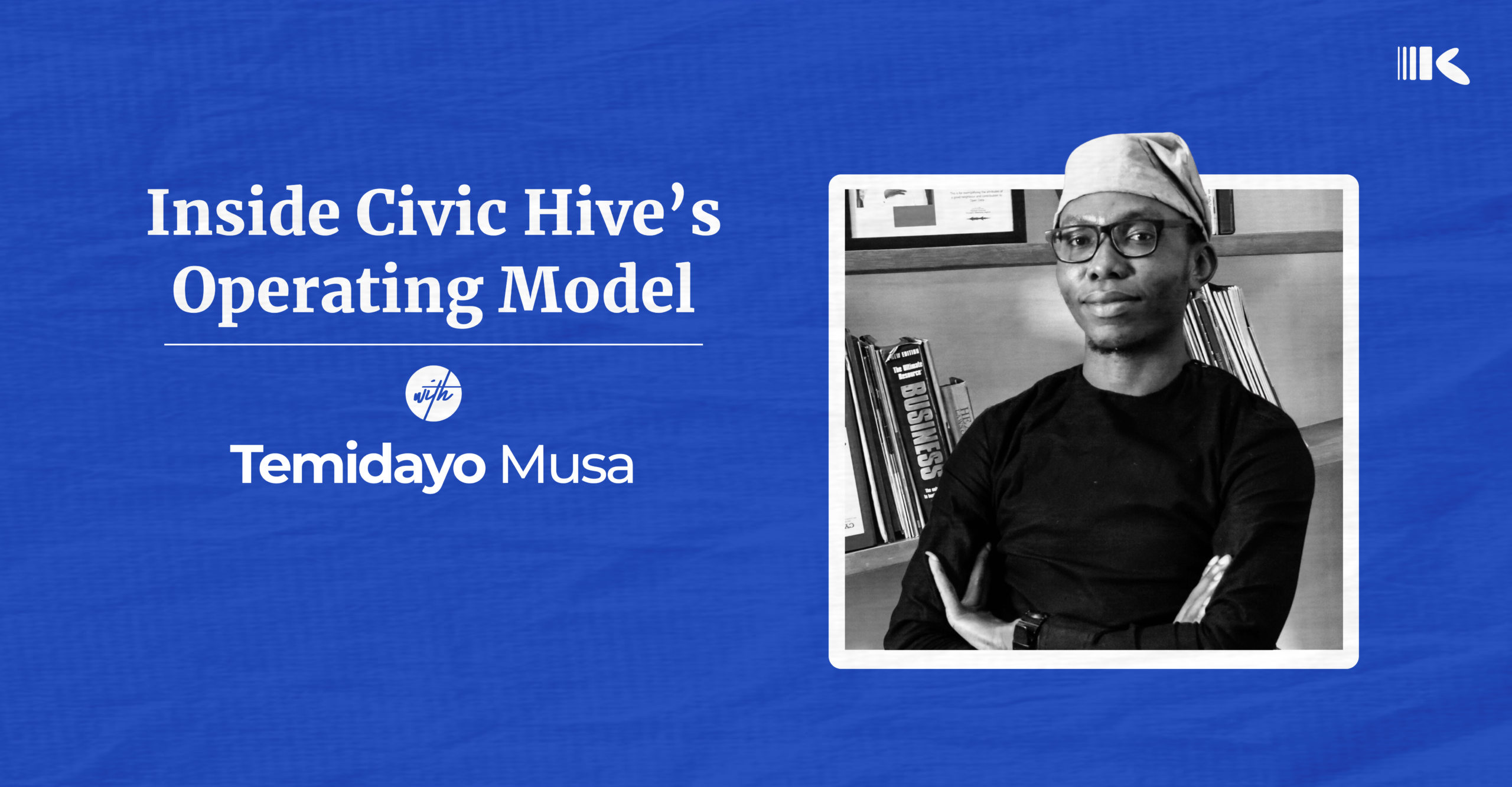
This week, we’re speaking with a nonprofit operator with close to 10 years experience leading programs, projects, and operations across health, youth development, civic engagement, innovation, and technology, as he shares how he translates vision into systems at Civic Hive so programs, people, and partnerships can scale without losing quality or impact.
Hello, can we meet you?
Hi, my name is Temidayo Musa. I am a programs, operation, and communications professional who loves using creativity, technology, and community-driven ideas to make civic participation, governance, and democracy more accessible and effective. Previously, I have worked with organizations like The Nest Innovation Hub, Dalberg, the Borno State House of Assembly, Wellbeing for Women Africa, Oxford Policy Management, and the Commonwealth Youth Programme on advocacy, research, and innovation work across Nigeria and beyond. Currently, I lead operations and programs at CivicHive. Outside work, I love wine, visual arts, and I’m a Taylor Swift fan.
Civic Hive has incubated 34 startups, supported 107+ organizations, and runs fellowships, hackathons, and a co-working space all at once.
When people hear “Head of Operations,” they often think of admin and logistics. But you operate in an ecosystem-building organization.
How do you define “operations” at Civic Hive? What does your role actually entail day to day?
At Civic Hive, operations go far beyond admin or logistics. We can see it building and managing the systems that allow people, programs, and ideas to work and scale sustainably. Day to day, my role sits at the intersection of strategy and implementation, coordinating teams and partners, managing programs and resources, and ensuring that everything can run simultaneously without losing focus, quality or impact. In practice, it means translating ideas/vision into structure, solving challenges, and creating that space that makes CivicHive a melting pot for youth, innovation, and creativity.
In 2017, Civic Hive supported a handful of fellows. Today, you have worked with 107+ organizations and run multiple programs concurrently. What operational systems or infrastructure did you have to build to scale from supporting a few organizations to over 100?
I would have said “Na God o.” But in truth, it started with a vision; the founder’s clarity about what Civic Hive should become and the commitment to build for the long term, not just the moment. My role was to run with that vision and translate it into structure, systems, and everyday decisions that could support scale.
Equally important were the people. Getting the right people in the right roles, trusting them with ownership, and aligning everyone around shared values and outcomes. As Aristotle put it, “The whole is greater than the sum of its parts.” So when you have a clear vision, and the right people, everything works together for good.
Civic Hive partners with everyone from foundations to local communities. That is a complex stakeholder ecosystem. How do you operationalize partnership management at that scale? What systems keep you organized and partner-focused while juggling that many relationships?
At Civic Hive, we genuinely love working with people across the spectrum. From big foundations and institutions to grassroots communities and groups. We are big about meeting diverse stakeholders where they are, and we try as much as possible to provide the support they need. Because, in the end, supporting them helps us achieve our overarching goal.
Operationally, we keep things simple, clear goals, flexible engagement models, and a dedicated point person for each partnership. This helps us stay organized while keeping relationships collaborative, and responsive, no matter the partner.
Funders love funding programs, fellowships, hackathons, and direct services—but operations infrastructure is harder to fundraise for. How does Civic Hive budget for operational capacity? How do you make the case internally and to funders that investing in operations is programmatic investment?
Let me start by saying that donors do fund operations. There are funding types such as Sunrise grants, BUILD grants, and others that are designed to support the organization itself rather than a single project. In addition, many traditional program grants allow organizations to allocate a defined percentage of the budget to cover operational and administrative costs required to deliver the project effectively.
Speaking of infrastructure, what tools and technologies are indispensable to you as an operator, and why?
I have a big reliance on Google’s business tools: Docs, Sheets, Drive, Calendar etc. This is because they keep everything collaborative, and accessible across teams.
Most nonprofit founders start their organizations because they care about an issue, not because they have operational experience. What is your advice to founders who are reluctantly handling operations themselves and do not know where to start? What are the three most important operational foundations every early-stage nonprofit needs?
My advice is simple: don’t try to do everything at once. Nonprofit operations can feel overwhelming, but it’s really about creating enough structure to let your mission breathe. If you have the passion, find someone that understands the operations, and vice versa. Importantly, understand the issue you are trying to solve critically, the operation might not be strategic, but if you are very very willing to learn, you will fine tune your process.
Importantly:
- Start with a clear problem, not just passion
- Build simple systems from day one
- Invest in people and partnerships early.
How do you know if operations are working? What are your KPIs for operational health beyond “programs launched on time” or “budget balanced”?
For me, operations are working when things don’t break as volume increases. It is when delivery is predictable and friction is very low. I also look at how near accurate our planning is, how smooth team mates work, how quickly issues get resolved, and whether teammates can manage multiple activities without quality dropping. If programs can be repeated using the same playbook and teams aren’t constantly firefighting, then the operation process is good.
If a nonprofit founder with limited resources asks you which roles are most important to hire first, what would you say?
I would say don’t hire for titles; hire for existing gaps.
In the beginning, the most important roles are the ones that keep the work moving and the organization lean. This aligns with the Theory of Constraints, which says performance improves fastest when you identify and strengthen the weakest link in the system.
Lastly, if you were to give a nonprofit founder advice on building an organisation that is scalable, what would it be?
If you want to build something scalable, stop building around yourself. Build around clear problems, and people will naturally take ownership.
Build solutions that actually solve problems.
What becomes clear from this conversation is simple. Strong nonprofits are not built on passion alone. They are built on people, systems, and deliberate operational choices that make impact repeatable.
Many thanks to Temidayo Musa for having this conversation with us and answering all our questions – and swiftly too, we must add.
Do you love this content or have any feedback for us, leave a comment below.