
Based on popular opinion—mostly mine—Nigeria is regarded as the humor capital of the world. Not just because of our incredibly hilarious way of thinking, but our ability to find the silver lining in every cloud. No matter how hard it gets, we find a way. We’re simply water, we adapt.
The 1000% increase in the number of nonprofit organizations between 2019 and 2023 is a demonstration of good intentioned Nigerians creating the solutions the government hasn’t seemed to get around to.
The Corporate Affairs Commission in 2023 stated that there were over 191,278 registered nonprofits in Nigeria. Despite this scale, 60% are struggling with fundamental issues like weak organizational structure and lack of funding.
Now, the big question is, what exactly does it take for good intentions to translate to tangible results?
HOW TO BUILD A TRANSGENERATIONAL NONPROFIT IN NIGERIA
- BUILD A SOCIAL ENTERPRISE AND ENSURE FINANCIAL STABILITY
Many nonprofits in Nigeria start out as the founder’s personal project, and very few founders are able to communicate their mission well enough to help the nonprofit transition from being a passion project to being a social enterprise.
Most nonprofit founders in Nigeria leverage their fame and influence to grow their nonprofit. They’re the chief fundraisers and the face of the nonprofit. Many people who support the nonprofit or volunteer with the nonprofit are more inspired by the founder than the mission.
As a matter of fact, the founders are known as social entrepreneurs and philanthropists but their organizations rarely show up when the conversation is about nonprofits with tangible results.
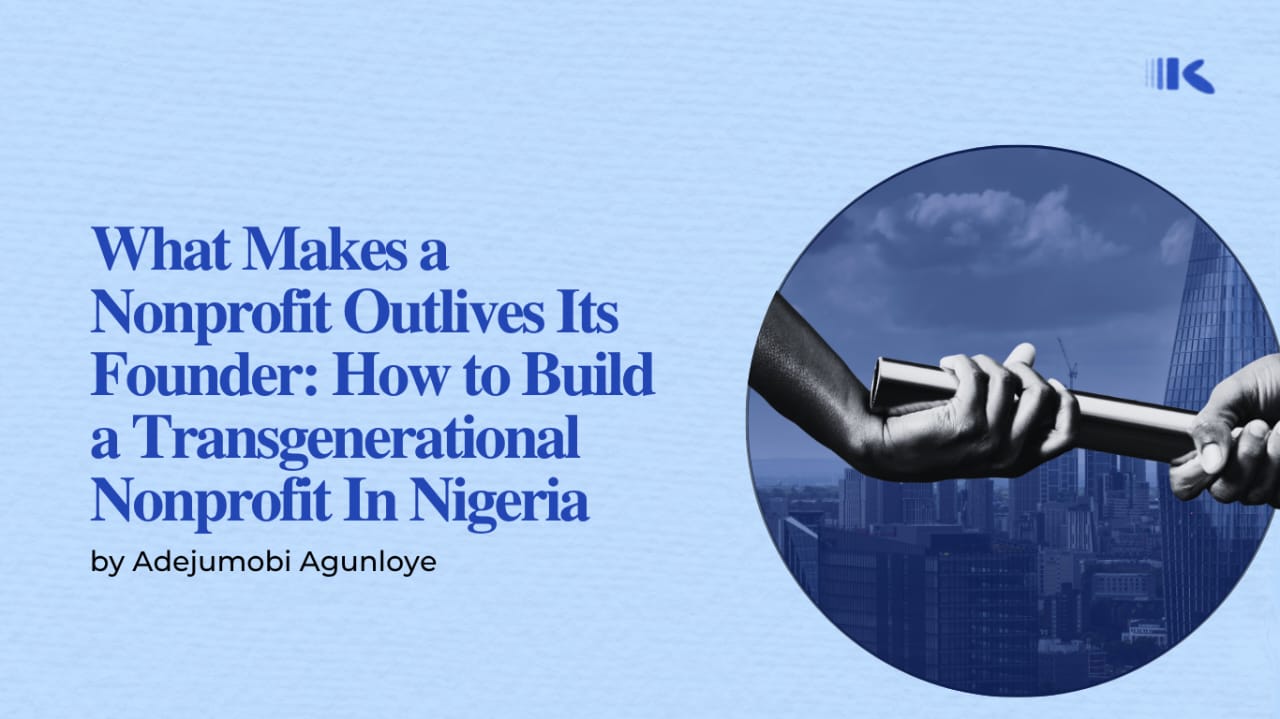
Every nonprofit that will outlive its founder must grow beyond the founder. The nonprofit must be able to stand beside or without the founder. So while you’re leveraging your personal resources to grow the NGO, you must put systems and structures in place to ensure continuity and sustainability.
- ESTABLISH STRONG GOVERNANCE STRUCTURES AND PLAN FOR SUCCESSION
The Nigerian Corporate Affairs Commission requires that every nonprofit put a board system in place before registration. But more often than not, the contribution of the board members is limited to paperwork. The founder is usually the alpha and omega of the organization.
The primary argument in favor of this is that the founder understands the vision and mission better than anyone else. While this is true, the founder is also a flawed human being with bias and a strong—sometimes problematic—emotional connection to the organization.
In this case, the board members and trusted leaders are needed for both separation of powers and checks and balances. Governance structures are there for us to learn from.
There’s also the issue of succession, which shouldn’t be an issue but many Nigerians are spooked by anything that remotely concerns death. But succession should be more about evolution and transitions than death. Truth is, people who are founders at heart rarely stop at one organization. How about you create more solutions and give people the opportunity to contribute their own quota?
- INSTITUTIONALIZE VALUES AND CULTURE, AND TRAIN LEADERS
Your first responsibility as a leader is to train other leaders. And you’re not a successful leader until you’ve trained other people to be better than you. When you have people who care about the work, can do the work, and actually do the work, you have succeeded in creating a system that works without you. And how do you get these kinds of people? Through training.
As a social entrepreneur, my first responsibility is not to my beneficiaries; it is to my volunteers. My volunteers are my first beneficiaries. Why? Because people can’t give what they don’t have. If I don’t train my volunteers to be valuable, my beneficiaries will get nothing but crumbs.
And training is not just about skills, it’s also about values and culture. Building a nonprofit is building a community, and every community should have core values and a clear culture. Most founders do but the question is, are the volunteers aware?
You say that your nonprofit will be known for creativity and proactivity, but are your volunteers aware? Do you have a document that explicitly states this? Do you enforce it through training and by practicing it yourself?
It’s not just about what you say. It’s about what you do and what you intentionally emphasize.
TRANSGENERATIONAL NONPROFITS
The best way to learn how to cook jollof rice is to attentively watch someone else cook jollof rice, take notes, and ask questions. So if building a transgenerational nonprofit piques your interest, you must learn from those who have done it before and study what they’ve built.
NIGERIA NETWORK OF NGOS (NNNGO) – Founded in 1992 by Yemisi Ransome-Kuti, NNNGO is the first general membership body for civil society organizations (CSOs) in Nigeria. They have over 3900 members with a central focus on strengthening the nonprofit sector by promoting transparency, accountability, and evidence-based advocacy for sustainable development.
THE SALVATION ARMY – Founded in 1865 by William Booth in London, The Salvation Army is an international church and charity organization dedicated to meeting the basic needs of less privileged people without discrimination in over 130 countries. Their strategies include humanitarian aid, food distribution, disaster relief, social services, and thrift stores.
THE ROCKEFELLER FOUNDATION – Founded in 1913 by John D. Rockefeller, The Rockefeller Foundation is committed to alleviating human suffering. With its primary base in New York City, the foundation spearheads public health, education, and economic development initiatives
ROTARY INTERNATIONAL – Founded in 1905 by Paul Harris, Rotary International is a service oriented organization with over 1.2 million volunteers worldwide. With over 34,000 clubs, the organization is focused on peacebuilding, education advocacy, provision of clean water, and disease prevention (especially the eradication of polio).
SAVE THE CHILDREN – Founded in 1919 by Eglantyne Jebb, Save the Children is a global children’s rights organization committed to providing emergency relief, health care services, education, and protection to children in over 100 countries. They’re working towards a future where all children are educated, protected from violence, and no child dies from preventable causes.
The most obvious thing about these organizations is that we know them but we don’t necessarily think about the founders. Why so? Because these founders built beyond themselves from the start. NNNGO had an active board from the beginning. Salvation Army, Rotary International, and Save the Children were built in a way that individuals could find their purpose in the work and expand the operations.
When we say you can’t eat your cake and have it in the context of Nigerian nonprofits. It means you can’t build a transgenerational nonprofit if you’re not willing to build beyond yourself.
If you want to be at the center, start a personal brand. But if what you want to do is create solutions generations yet unborn can benefit from, look beyond yourself and build for the future.