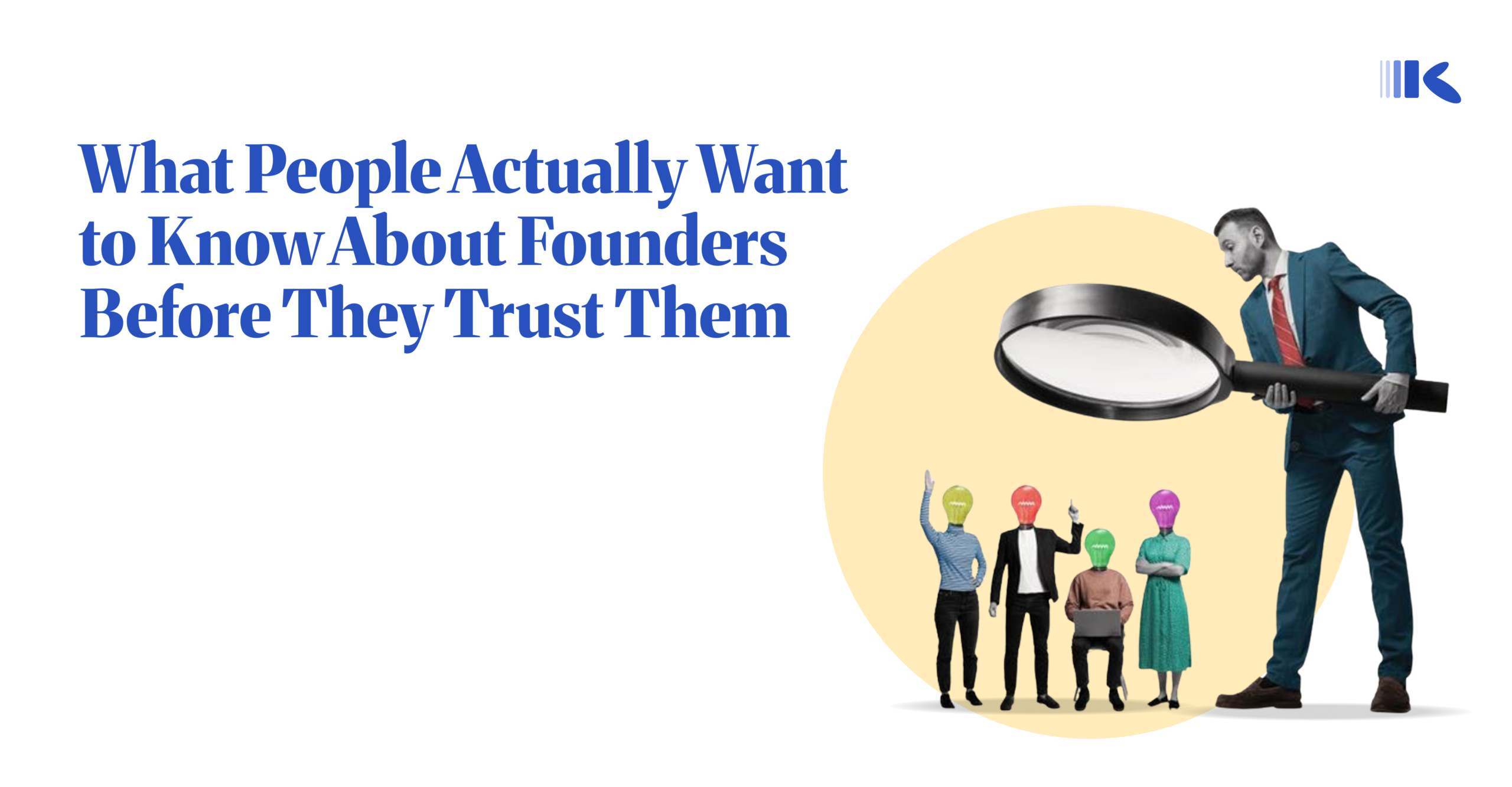

In the nonprofit space, there are a lot of unknowns. Google searches on founder education are replete with questions such as: how to source funds for a project; how to attract grants for a startup; how to pitch investors, how to upscale; how to build a board; what organizational traits a young founder should imbibe; what structures need to be adopted in a rapidly changing technological world; what metrics can be used to measure organizational growth; where and how to recruit team players Yet, there is still one pressing question that begs to be answered: “What do I need to know before trusting a founder?”
Whether you’re a nonprofit founder or just someone with a nose for founder gossip, it helps to know what people are looking for when they google your name. Donors, investors, volunteers, and potential partners often make snap decisions based on the information they find, using it as a proxy for whether your nonprofit is credible and capable of delivering on its promises. In this article, we’ll explore six areas people check before trusting a founder. With this knowledge, you’ll be better equipped to position yourself and company in the best possible light.
Letting the Cat Out of the Bag: Defining Founder Trust
Trust is one of those concepts that seems straightforward until you start unpacking it. Much like peeling an onion, layer after layer reveals new dimensions. At its core, trust is the confidence that someone or something will act reliably and as expected. In the nonprofit world, Founder trust is the confidence that stakeholders place in a founder’s word, judgment, and follow-through, built through repeated evidence that the founder does what they say and acts in good faith when things go wrong.
For nonprofits, trust is not just a desirable quality, it is a form of social capital. Think about trying to start a business with no money of your own; trust can serve as a currency to buy people to invest in your vision, partner with you, or give you a chance before you’ve proven yourself. This is why one of the most enduring rules of thumb for nonprofit founders is simple: build trust. It can take years of kept promises to build and a single bad decision to spend. However, you can’t build trust as a founder when you don’t know the boxes people tick when searching for your name.
Key Areas People Look Out For Before Trusting A Founder
In the nonprofit space, people look beyond the project to examine the person behind it. A LinkedIn article highlights soft skills, plus experience and track record, as key pointers to building public trust for a successful startup. Below are other areas people look out for before trusting a founder:
#1 Character
“People don’t buy what you do; they buy why you do it and what you do simply proves what you believe.” — Simon Sinek
Let’s be honest: one of the first things people want to know about a founder is what kind of person they are. Beyond the polished LinkedIn profile, media features, social portfolio, and impressive achievements, people are curious about your character. Are you honest? Do you keep your word? How do you treat people when there’s nothing to gain? These questions matter because the public are not just buying into an idea, they are also buying into the person leading it.
Whether it’s a donor considering a contribution, a volunteer deciding where to commit their time, or a partner exploring a collaboration, they’re putting more than money on the line. They’re investing their trust, reputation, knowledge, and networks. Naturally, they want to know whether the founder is someone they can confidently work with over the long term. A thought piece suggests that investors are more likely to invest in a nonprofit if they trust the founder’s capabilities. However, if there are doubts about a founder’s credibility or reliability, many will simply take their support elsewhere.
This is why people often go digging. They ask around, search online, and pay attention to how founders show up in public and private spaces. They’re not being nosy for the sake of it; they’re trying to determine whether the founder’s actions match their claims. At the heart of that assessment is personal integrity.
#2 Personal Integrity
Character is who you are, integrity is how consistently you live out who you are.
According to research by organizational scholars Roger Mayer, James Davis, and David Schoorman in their influential model of trust, integrity is a core dimension of trust, second only to ability and benevolence. An investor report from an investigation of the portfolio of world-changing companies globally also highlighted integrity as one of the six qualities every founder needs. However, founders tend to assume they are more trusted than they are. In PwC’s Trust Survey, 87 percent of executives believed customers highly trusted the company, while only 30 percent of customers said the same.
Also, many founders assume that their potential investors tend to run a background check only on financial statements and organisational structures. Meanwhile, people are often asking questions such as: Does this founder keep their word? Do they honour commitments? What happens when nobody is watching? Can they be trusted with confidential information? Are they transparent about mistakes? The reality is that founders rarely lose trust because they made mistakes. More often, they lose trust because they try to hide them. In a sector where credibility is currency, integrity functions like compound interest. Every promise kept accumulates trust. Every broken promise withdraws from it.
#3 Competence
“A compelling mission may win hearts, but competence wins confidence…”
After people have satisfied their curiosity about your integrity, the next question is usually a practical one: Can this founder actually get the job done? A newsletter article defines competence for a founder as persistent repetition measured at the finish line. In other words, people actually want to know if a founder is good at not stopping. Beyond passion, they want to know whether the founder has the skills, knowledge, and experience needed to turn good intentions into measurable impact. After all, the nonprofit sector is filled with worthy causes; what often separates successful organizations from struggling ones is competent execution.
People pay close attention to signs of competence. They look for evidence of sound judgment, strong problem-solving abilities, effective resource management, and the ability to build and lead teams. They want to see how a founder has handled challenges in the past and whether they can adapt when the chips are down. And yes, people also pay attention to who is in your corner. Stakeholders often assume that capable people are drawn to capable leaders. If respected professionals, advisers, board members, and team members have chosen to work alongside you, it signals confidence in your ability to lead. In many cases, the quality of a founder’s network becomes a proxy for the quality of the founder themselves. Think of the PayPal Mafia phenomenon in Silicon Valley. Many founders who emerged from PayPal found it easier to attract talent, investors, and partnerships because of the people associated with them. Their networks acted as a trust signal. This is why people often pay attention not only to what founders have built, but also to who believes in them and how they treat those who cannot benefit them.
#4 How They Treat People Who Cannot Benefit Them
“People may forget your pitch deck, but they rarely forget how you made them feel…”
If there’s one kind of founder gossip that spreads faster than funding announcements, it’s how a founder treats people. Anyone can be warm and attentive when they’re speaking to a donor, a grantmaker, or a potential partner. But the way a founder treats people when there’s nothing obvious to gain often becomes one of the strongest signals of whether they are worthy of trust. For instance, a founder who yells at waiters but smiles at investors is likely inauthentic; a leader who is rude to janitors or support staff can be seen as lacking genuine respect for others; ignoring volunteers or interns shows that a leader only values people who bring direct profit or status. These are the moments people notice, and they talk about them far more than founders often realise.
In fact, many people’s opinion of a founder is shaped by stories they’ve heard rather than speeches they’ve watched. A single account of how a founder handled an uncomfortable conversation, responded to criticism, or treated someone with less influence can travel through professional networks surprisingly quickly. That’s because people see everyday interactions as windows into a person’s values. A beautiful example is the ugly example Steph Korey, the former CEO of the popular luggage startup Away, left in the company. According to this interview, employees revealed she routinely scolded workers in public and forced them to work exhausting hours. After a major news report exposed this, she stepped down. Pretty sure the bad news hung up her boots before she could!
#5 Sustainability
“Can this founder build something?” Vs. “Can they build something that lasts?”
People often ask themselves before trusting a founder: “If this founder stepped away tomorrow, would the organization still exist?” People want to know whether they’re supporting an institution or simply funding one person’s passion project. When every decision depends on the founder, every relationship flows through them, and all the organisational knowledge lives in their head, it may look like strong leadership. To experienced stakeholders, however, it often looks like a risk.
This concern isn’t just anecdotal. The USAID NGO Sustainability Index warns that organisations become less sustainable when they are essentially “one-man shows,” relying almost entirely on the founder’s personality and leadership. Organisations with documented systems, strong governance, and leadership succession are viewed as significantly more resilient because they are built to outlive the founder rather than revolve around them. A 2021 systematic review buttressed this truth by highlighting that stakeholders, including donors and prospective funders, expect evidence that the organisation can endure and remain accountable over time. However, the longevity of the NGO is largely hinged on the commitment of the founder.
#6 Commitment
Talk about commitment and you’re talking about Wendy Kopp. What began as a university thesis evolved into decades of work improving educational equity through Teach For America and later Teach For All. Her sustained commitment over many years gave funders and partners confidence that they were investing in someone devoted to solving a problem rather than chasing a trend. What you need to learn from this story as a founder is that the public pays attention to your consistency, despite the influx of new nonprofits launched yearly in response to trending issues, viral moments, or funding opportunities.
Before a founder is trusted, donors and partners search for evidence of long-term commitment: the consistency of a founder’s work, the willingness to keep going through setbacks, and the discipline to remain focused even when progress is slow. People notice whether a founder has invested years learning about the problem they are trying to solve or whether they appeared only after the issue became popular. These patterns help them distinguish genuine conviction from passing enthusiasm. At the end of the day, people are not just asking whether your mission is important. They’re asking whether you’ll still be showing up for it five or ten years from now.
The Bottom Line
Dear Founder, people won’t trust you because you have a compelling vision, an impressive pitch deck, or an inspiring social media presence on LinkedIn or IG. They pay attention to far more important factors discussed in this article. The encouraging part is that trust isn’t a personality trait reserved for a lucky few; it’s something you build intentionally through integrity, accountability, competence, humility, and consistent service over time. So rather than trying to appear trustworthy, focus on becoming the kind of leader whose reputation speaks before they enter the room. If you’d like to go deeper, you can assess and better understand trust using the Community Engagement Hub’s Trust Assessment and learn practical leadership behaviours that foster trust in Harvard Business Review’s “How Leaders Build Trust.”
Do you want to learn about building a nonprofit on the continent? Follow us here