
There is an old saying that a candle loses nothing by lighting another. In the nonprofit world, however, we have somehow come to expect that the candle should keep burning without ever replacing its own wax. We celebrate sacrifice, applaud resilience, and champion purpose, yet rarely pause to ask a difficult question: who sustains the people sustaining the mission?
For decades, conversations around founder compensation have occupied an awkward corner of the social impact sector. They are whispered in boardrooms, avoided in donor meetings, and often reduced to assumptions that purpose and financial security cannot coexist. Somewhere between the language of service and the expectation of selflessness, nonprofit leaders have found themselves navigating an impossible paradox—expected to build resilient organisations while personally embracing instability.
But perhaps the conversation has never really been about money.
Perhaps it has always been about communication.
The stories organisations tell, or fail to tell, shape public trust, donor confidence, leadership credibility, and even the way founders value their own work. When communication leaves gaps, assumptions quickly move in. Transparency becomes optional, speculation becomes inevitable, and sustainability quietly becomes the first casualty.
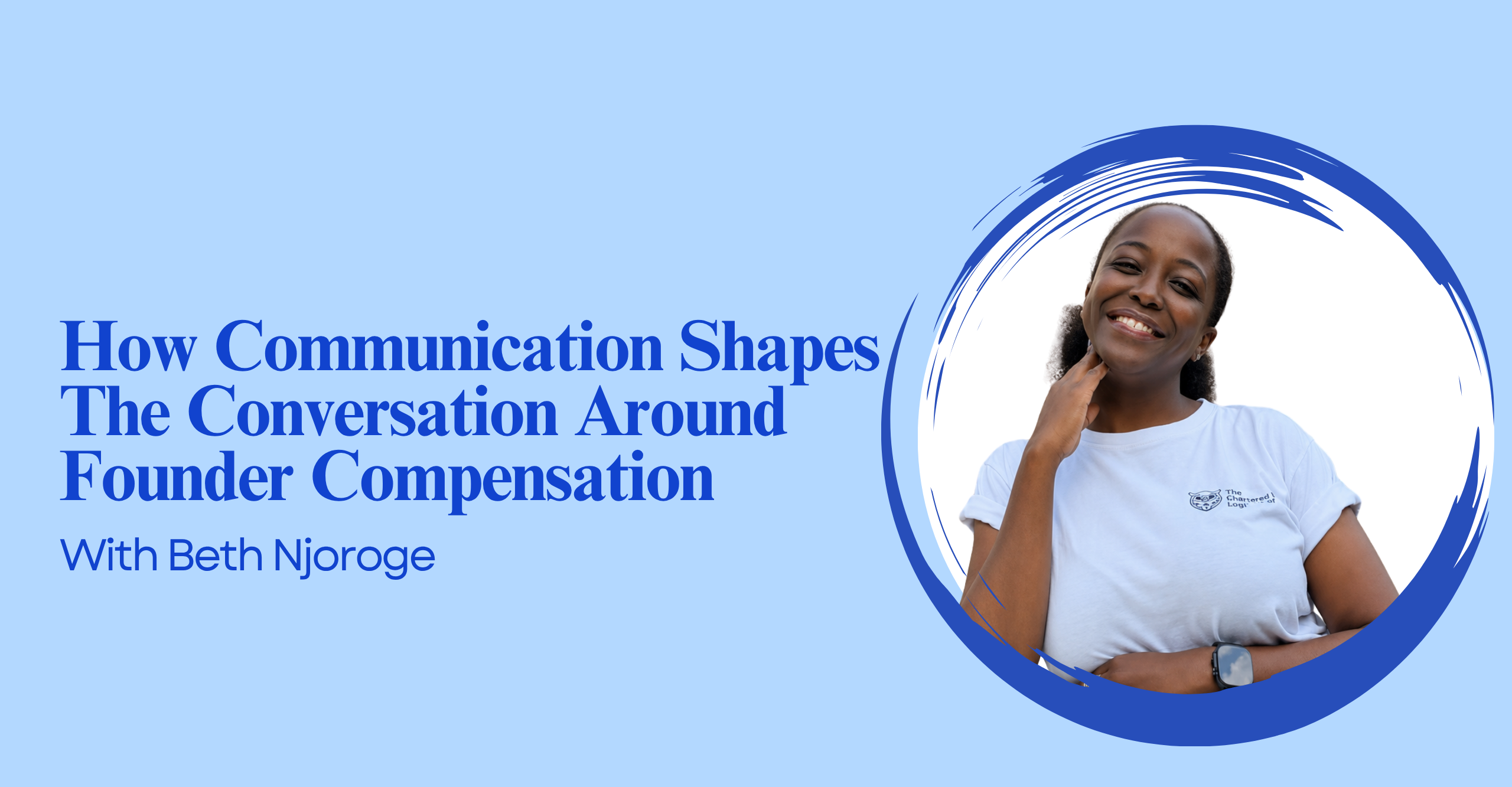
In this edition of #ForFounders, we sit down with Beth Njoroge, Founder and Communications Strategist at The CrystOwl Lab, whose work helps nonprofit organisations communicate with greater clarity, authenticity and purpose.
Before we dive into the conversation, tell us a little about yourself and what inspired your journey into nonprofit communications.
Hello, I’m Beth Njoroge, Founder and Communications Strategist at The CrystOwl Lab, a creative and communications agency helping nonprofits build trust through branding, storytelling, and digital communications.
My journey into the nonprofit world began in advertising, where I had the privilege of working on purpose-driven campaigns that proved just how powerful creative communication can be. Campaigns like the Elton John AIDS Foundation’s #ChukuaSelfie and Knight Frank Kenya’s #FrankThePlant showed me that when creativity is paired with purpose, it can spark conversations, shift behaviour, and inspire action at scale.
Those experiences left me wondering why that same level of strategic creativity wasn’t more common in the nonprofit sector, despite organisations tackling some of society’s biggest challenges. Later, my work with the United Nations World Food Programme cemented that conviction. It reinforced my belief that impact deserves communication that’s just as thoughtful, strategic, and creative as the work itself. That belief ultimately led me to build The CrystOwl Lab.
Founder compensation remains one of the nonprofit sector’s most sensitive discussions. Why do you think this conversation is still so uncomfortable?
I’d confidently charge it to expectation. Society expects sacrifice from nonprofit leaders in a way it rarely expects from founders in the private sector. Somewhere along the way, we started mistaking “nonprofit” for “free.” There’s an unspoken belief that if you’re driven by purpose, you shouldn’t also want or need financial security. Passion and compensation are often treated as opposites when they really aren’t.
I run a nonprofit creative agency, and I find myself explaining at least twice a week that it’s my clients who are nonprofits. People are often surprised to learn that supporting mission-driven organisations can also be a profession. Those conversations reveal just how deeply we’ve blurred purpose with unpaid labour.
Has the nonprofit sector unintentionally created a culture where sacrifice is treated as proof of commitment?
Yes, and I think frontline staff experience it most acutely. In many organisations, commitment is quietly measured by how much people are willing to give up, whether that’s time, financial stability, or their wellbeing. We’ve glorified sacrifice, and sustainability has paid the price.
The irony is that burnout doesn’t strengthen a mission. It weakens it. Organisations that expect people to continuously subsidise impact with personal sacrifice eventually pay the price through high turnover, exhaustion, and lost institutional knowledge. You can only outrun those realities for so long.
If organisations are to build sustainably, what should fair compensation for nonprofit founders actually look like?
Fair compensation should reflect responsibility, leadership, and value, not the assumption that purpose should come at the expense of financial security.
Donor trust isn’t necessarily eroded because founders are paid. It’s eroded when organisations fail to explain how compensation is determined and the value that leadership creates. Transparency and good governance make those conversations much easier.
How much does communication influence whether founders feel comfortable paying themselves?
Most founders understand they deserve fair compensation, but many don’t feel comfortable talking about it publicly. Public perception has created an environment where even reasonable salaries are viewed with suspicion because facts are often absent from the conversation. In the absence of information, people fill the gaps with assumptions. That leads to guarded silence, and silence creates space for even more speculation.
Interestingly, organisations that proactively explain their finances and governance often face fewer trust issues because supporters aren’t left to fill in the blanks. People trust what they understand, and they distrust what they have to guess.
Can talking openly about founder compensation actually strengthen trust with donors and supporters? Why?
Absolutely. Transparency is one of the strongest trust-building tools an organisation has, especially when it’s paired with explanation, because it replaces uncertainty with understanding.
GiveDirectly is a great example. They don’t simply publish financial statements. They explain why nonprofit finances are often misunderstood, why overhead isn’t always the right metric, and how supporters should think about efficiency instead. That’s what effective communication looks like. It reduces speculation because people aren’t left trying to interpret complex financial information on their own.
How can nonprofits communicate founder compensation without appearing to compromise their mission?
People are generally more accepting of fair compensation than nonprofits assume. In fact, they’re increasingly asking for more honest conversations about money, whether that’s during recruitment, while reviewing charity budgets, or when deciding where to donate. The challenge isn’t compensation itself. It’s that founder contributions are often invisible.
Telling supporters that a founder attended a “high-level, multi-sector meeting” doesn’t explain why that meeting mattered. What decisions were made? Which partnerships were secured? What funding was unlocked? What systems were strengthened? That’s the story people need to hear. Compensation becomes much easier to understand when people grasp the value founders create.
What communication mistakes do nonprofits commonly make around leadership, funding and sustainability?
Many nonprofits communicate in campaigns instead of conversations. Leadership stories often focus heavily on founders while overlooking the teams delivering impact every day.
Funding messages can become overly transactional, where every story ends with “Donate now.” Sometimes supporters simply want evidence that meaningful, long-term change is happening. Not every story has to end with an ask.
Financial sustainability is almost invisible in nonprofit communications. Few organisations explain how they diversify income, prepare for funding gaps, or make strategic financial decisions. Yet those are exactly the conversations that build confidence and strengthen trust.
What branding habits distinguish nonprofits that earn lasting public trust?
One of the biggest misconceptions I see is that nonprofits confuse branding with striking creative. Branding is really about predictable behaviour.
The organisations that earn lasting trust communicate consistently whether they’re celebrating success, navigating setbacks, or asking for support. Their voice doesn’t disappear between campaigns. Their values show up unmistakably in how they share information, respond to questions, admit mistakes, and explain difficult decisions.
Brand consistency is really consistency of character. While visual identity can be redesigned over a couple of weeks, character is built every time an organisation communicates.
You’ve talked about consistency as the core of trust. Has that same principle ever been tested in a real donor relationship?
Funding rarely follows a good story alone. It follows trust. Creative communication can open the door, but long-term donor relationships are built through consistency, transparency, and delivering on your promises. That’s changed how I think about communications. It’s not about winning attention. It’s about earning confidence over time.
What’s a pattern you’ve noticed in donor conversations that almost fall apart, and what tends to change the outcome?
Rather than one conversation, I’ve seen a recurring pattern. The toughest donor conversations happen when organisations feel they need to present perfection. In my experience, honesty builds stronger relationships than polished narratives. Acknowledging challenges while showing how you’re responding to them often creates more confidence than pretending everything is going according to plan.
How do you navigate moments when mission and donor expectations pull in different directions?
I’ve learned that the strongest partnerships happen when expectations are aligned from the beginning. For me, a mission should guide communication, not bend to funding. The right partners invest in your purpose because they believe in it, not because you’ve reshaped it to fit what they want to hear.
Looking ahead, how do you see AI changing nonprofit communications?
AI isn’t replacing nonprofit creative and comms work, but it is changing how that work gets done by making some areas of content creation easier. Ironically, it is also making authenticity even more valuable. The organisations that stand out will be the ones that know where not to use it.
Communities can usually tell the difference between automated empathy and genuine human understanding. The nonprofits that build lasting credibility will use AI to improve efficiency while protecting human judgment, lived experience, and the relationships trust depends on.
If every nonprofit founder could change one thing about the way they communicate, what would you encourage them to do first?
Meet people where they are instead of expecting them to come to you. Too many founders unintentionally become inaccessible. Communities want to ask questions, understand decisions, and see the people behind the mission. Trust grows through conversation, not broadcasts.
An emoji reaction isn’t engagement. Real engagement begins when people feel they’ve been invited into a conversation and, more importantly, when they feel heard.
Communication isn’t just about telling people what your organisation does. It’s about helping them understand why it matters, how the work happens, and giving them enough clarity that trust never has to rely on guesswork.
Conclusion
In a sector where purpose often speaks louder than profit, Beth Njoroge offers a timely reminder that sustainability should never be mistaken for selfishness. The future of nonprofit leadership depends not only on visionary founders or generous donors, but on honest conversations that replace assumption with understanding. Fair compensation, transparent governance, compelling storytelling and authentic engagement are not competing priorities, they are the foundations upon which enduring public trust is built.
As the nonprofit landscape continues to evolve, organizations that communicate with clarity, consistency and courage will be better positioned to earn confidence, deepen partnerships and amplify their impact. After all, missions may inspire people to act, but it is trust that keeps them walking alongside the journey.
Many thanks to Beth Njoroge for this conversation.
Do you want to stay up-to-date on the information and trends shaping the nonprofit sector? Join our community here.