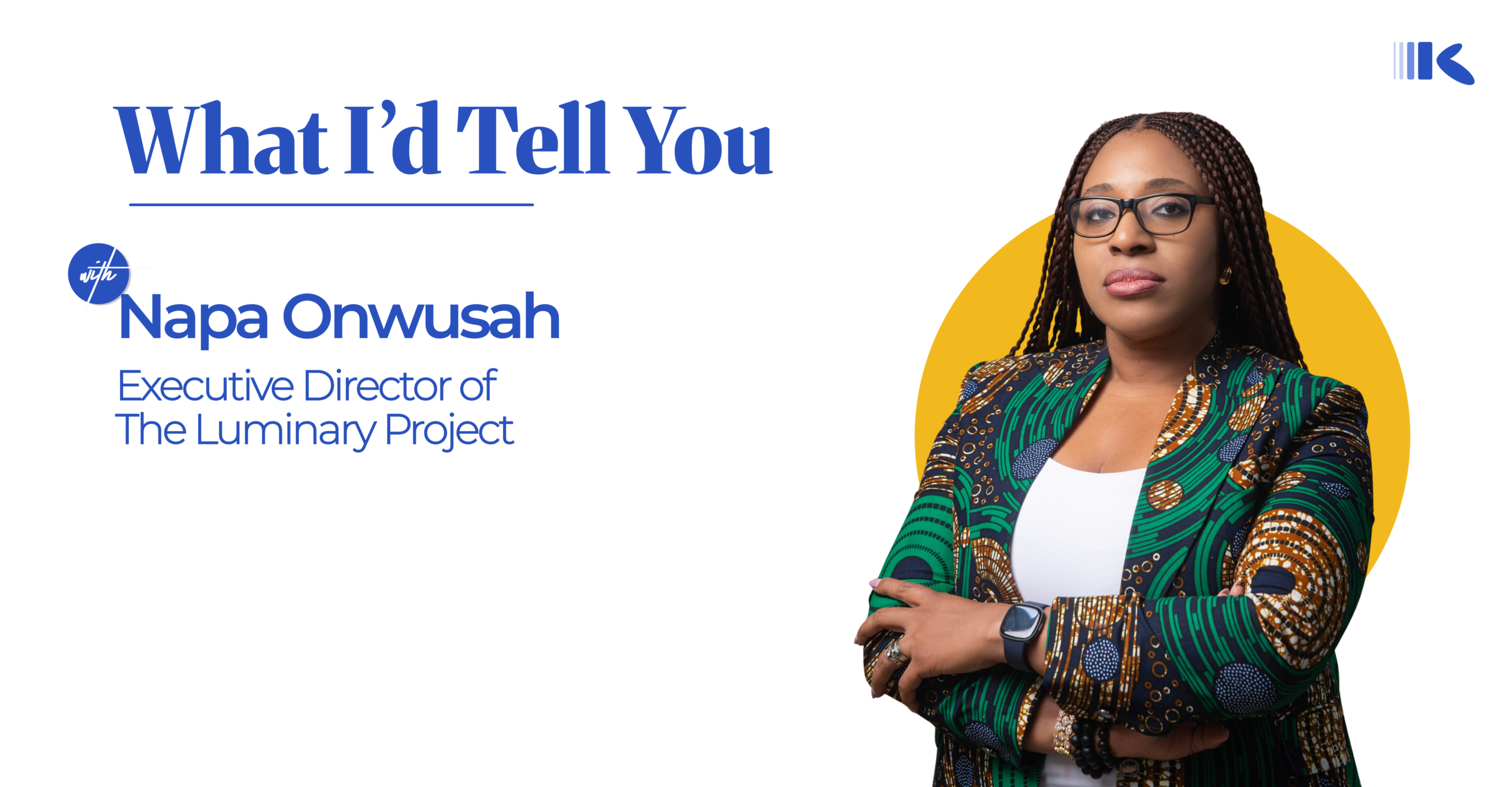

What I’d Tell You is a Kryvent series featuring experienced leaders across the social impact ecosystem. In each conversation, we ask them to look back on what they’ve built and what they’ve learned from occupying different roles within the sector. The aim is to pass something useful forward to the next generation of nonprofit and social enterprise founders building across Africa.
Welcome to the first edition.
Our guest today has spent over two decades leading business teams across global technology companies. She is a TEDx speaker, strategic advisor, and the Managing Partner of B4B Partners, a pan-African sales transformation and leadership consultancy. Through the social impact arm of B4B Partners, she now channels that experience into funding and developing grassroots changemakers across Africa. She is the Executive Director of The Luminary Project.
Hello, can we meet you
Hi, my name is Napa Onwusah. I’ve been in global tech for over 25 years and I’ve had the privilege of leading business teams across the Middle East, Africa, and parts of Europe. Two years ago, I transitioned into leading my own consulting firm called B4B Partners. We support businesses that want to grow and scale, from enterprise and public sector to startups and small businesses, through consulting, capacity building, and learning. But of course, even when you do all of those things, the most important part of life is really the impact you leave behind. The social impact arm of B4B Partners is the Luminary Project, which finds, funds, sustains, supports, and amplifies grassroots NGOs.
Most people who know your career know the Google and AWS version of you. Very few know you were also running the Jeremiah Foundation and funding scholarships for children in Nigeria. Where did that come from?
The Jeremiah Foundation is based on a verse in Jeremiah: ‘The thoughts I have towards you are thoughts of good and not of evil.’ Though we Christians take it out of context a lot, it is what it is. I believe that interventions in people’s lives can change destinies. If you take a girl who is 13, growing up in a family that may not be able to send her to school, simply exposing her to education could mean she chooses a different career, marries a different person, and even raises her children differently. It shifts the trajectory.
I went to a low-income area in Lekki, right opposite an affluent neighbourhood, and that contrast alone could shift your perspective. When I got there, there was no drainage and no beds in the houses, just mattresses on stilts. I started by going in to share the gospel. And once you’re there, you start asking what you can actually support with: food, clothing, those kinds of things. But I felt those weren’t interventions that could really shift destinies. So we started giving scholarships to kids.
Anyone in the impact world knows you have to stop yourself from falling into a tunnel of support. We started with scholarships, but then the kids didn’t have textbooks. So we started providing textbooks. We didn’t have enough money to buy textbooks for every student, so we opened a library where the kids could check books in and out. When they saw a fellow Jeremiah child mishandling a book, they would call me, because my number was essentially public property, and report it. That person knew they might need that same book next time.
After that we included calculators and uniforms. Then we noticed the mothers were struggling to earn money, so we started a widow’s fund. Eventually, I could no longer sustain it. We weren’t a big name, we couldn’t find funding, and it was my first time running any kind of impact work. I didn’t know NGO work is one of the most process-driven initiatives there is.
So I had to close it down. But that is what brought about the Luminary Project. I thought: we were giving scholarships to around 250 kids a year, but what if instead of reaching 250 kids directly, we found 20 organisations already impacting 250 or 500 people each, and gave them the funding, visibility, and support they needed? That felt like a better way and approach to it.
Aside from the Jeremiah Foundation, most of your experience is in the technology industry, where there are sales records, growth percentages, and investors looking at scalability and ROI. Now that you’re in the nonprofit space, has that created any tension in how you look at the organisations that come through the Luminary Project and their pitches? And what do you look out for?
I think you asked two questions. Let me answer what I believe is the first one: is there tension? Yes, there was tension, but not in the area you might expect. I’m a great believer in skill stacking and experience stacking. All the experiences and skills you have are meant to help you in your next move, not prompt you to abandon everything from your past just because you’re now in the impact space. So in our trainings, we actually challenge our changemakers and the NGOs we work with to start thinking about business models.
Yes, you have volunteers. Yes, you’ll apply for grants. Those things are important. But how do you make your NGO sustainable? How are you thinking about revenue streams and building partnerships? We have an upcoming webinar with our NGOs next week, and that is exactly what we’ll be discussing. We bring a lot of structure and conversations that make clear you cannot run on passion alone, as much as you might want to. The reason many NGOs shut down is that people believe passion is enough.
When NGOs are telling you about their ideas, for example, there is a founder we’re working with now whose mother died from diabetes. She is deeply passionate about it, and when she speaks about it, she wants to go to that deep place. We tell her: yes, that depth is good, it keeps you going when things get hard. But now tell us more about how you manage the revenue that comes through your organisation. It forces them to be more structured and to think about the sustainability of the work. Because if your mother died from diabetes, you have to put a structure in place that allows somebody else’s mother not to die. If you run on passion alone, you may not get there, and someone will not benefit from everything you went through simply because structures were never put in place.
On the second part of your question: passion is one thing, and their understanding of the problem is another. The third thing we want to understand is the gap between where you are and where you need to be to scale. Scaling impact is a bit different from scaling a business. In business, you scale based on successful growth, then replicate it in another country or product. Here, what we want to understand is how you think about tools. Even if you’re not yet using a CRM or a financial system, we want to see that there is some thought process around your expenses, income, and donations. If there isn’t, that is what our impact accelerator is designed to address. You go through a six-week programme before receiving any funding from us.
We also look at how engaged you are with the programme, and there is a capstone project at the end where you tell us what you will use the funding for over the year we’ll be working together. So we are looking for two things: people who already have those elements of structure and are demonstrating them without realising it, and people who, when given the opportunity to learn, close the gap even a little.
Those are the kinds of things we look for.
Through the Luminary Project, you’ve funded 15 organisations since inception. Looking back at the cohorts you’ve worked with, is there anything you’ve realised in retrospect about how your approach should have been different?
Of course. I think God has been very kind to us. We’ve had amazing cohorts and we are still surprised by the people we’ve found. Our first winner works with elderly people, that’s Project Grey. Then there’s YSIPS Foundation, which did leadership training last year.
Let me give you one pivot we made. Before, we used to select a single winner and work exclusively with that organisation. But we decided to pool more funding and distribute it across our top 20, then score that group down to our final 10. That change came from feedback. We take feedback from our Luminaries, our donors, our community, and ourselves. We are great believers in actionable feedback, meaning when someone gives it, we actually implement it.
And I think when you’re running on passion, without staying a little dispassionate about what you’re doing, you may not hear feedback at all. You start to feel like everyone is a hater, or that people don’t understand what you’ve been called to do. There have been so many changes I couldn’t list them all. With our impact accelerator, for instance, we had planned to deliver it entirely virtually. But when we brought in experts from across the NGO space, the feedback was that participants preferred live sessions with recordings available afterwards. So we adjusted.
We have our programme design, our quarterly reviews, all of those structures in place. And even on the funding side, instead of going straight to corporate sponsorship, which we are actively pursuing now, we started dedicating 5% of profits from B4B Partners to the Luminary Project. That was significant because it meant we weren’t constantly anxious about programme funding. And because we stabilised that base, we’ve been able to grow our impact and pursue larger external funding with more confidence. We are constantly evolving.
Beyond the cohort training and award ceremony, what impact are you looking forward to the most that the Luminary Project could have on the broader ecosystem?
We actually have three funds. Fund One is for whoever makes our top 20 or top 10 for that year. That money is granted in tranches, based on the performance of the project they commit to. Fund Two is for our Alumni. Fund Three is open to any NGO. We deploy all three funds once a year.
What is important to us in terms of supporting the broader NGO ecosystem is the conversation around structure for sustainability. I remember when I was running my own NGO, the amount of documentation required was just overwhelming. And then when you want to apply for a grant, pulling everything together, demonstrating impact, it could stop you before you even start.
That is why we built a free tech platform called Legit Good. It lets you manage your people, gives you a webpage similar to a LinkedIn profile, and lets you manage your finances, impact reports, donors, and generate reports. Because we recently registered in the US, we are also able to attract international funding, and NGOs can access that funding through the platform as well.
So in terms of ecosystem impact, I think it will come from Fund Three and from Legit Good, a tool that allows NGOs to become more structured without breaking the bank or stitching together five different systems.
Does Fund 3 run through an open call to the public?
Yes, it’s open. We share the thematic area of the fund and what we’re looking for in terms of outcomes. It runs as a funding call through published RFPs in select SDG focus areas, announced annually via Legit Good.
We are also very clear about what it is and how to apply. And remember, our funding is catalytic. The idea is that by the time you join the community, access some of the tools, attend some of the trainings, and receive some funding, you are already in a position to attract even more funding outside of Luminary. We’ve seen a lot of our NGOs do exactly that. Because they are now more structured, have a clearer view of their plans, and have developed their theory of change, they are better positioned, and you find them winning more grants and launching their own products.
The more time you spend working in and around the nonprofit sector, the more you’re exposed to how it actually operates. What is something you’re learning or grappling with?
One of the things I grapple with in the impact sector is that a lot of money stays at the top of the funnel and doesn’t cascade all the way down. One of our NGOs, for example, works with children placed in correctional facilities. It is remarkable work, pro bono hours, the kind of intervention that changes destinies. But she may still be passed over for a more visible, better resourced organisation with a higher public profile. That puzzles me, because impact work is precisely the work where you have to make sure money reaches the people actually doing it.
What I’ve often seen instead is funding flowing to large, established names while grassroots organisations are left behind. And the infrastructure gap goes beyond money. In the startup ecosystem, you still find accelerators and incubators, institutions that sit with you at the idea stage even when funding isn’t available. The impact space doesn’t really have a lot of that, and I find that striking.
I want to be clear that I’m still learning. I’m not someone who has been in this space for 25 years. When you come in from enterprise or global tech, you bring a viewpoint, but you also quickly realise how much you didn’t know. So I hold this loosely. What I do hope is to connect with people who share the belief that grassroots NGOs need to be supported early enough that they can grow into the kind of organisations that eventually attract larger funding. But I may be wrong.
For founders and young people building nonprofits who are looking for experienced leaders to come on board, how would you advise them when it comes to making that approach?
I’m thinking about this from the angle of: why do I say yes when I join a board? That might be the more useful way to approach it.
I say yes when I have a good understanding of the convener, the founder, the person behind it, and when there is an alignment of values. That means I have probably already been exposed to your work. So the first thing is: don’t approach a potential mentor or board member cold. If someone just finished speaking at an event and you walk up and say “come and join my board,” you will likely get a no.
The second thing is to be clear about what you actually need, because there is often a mismatch between the title and the role. You might be asking someone to be a board member when what you really want is a mentor. You might say mentor when what you want is a coach. You might say coach when what you actually need is a sponsor. In Nigeria especially, we tend to collapse everything into either “mentor” or “board member,” and that is not always the right framing.
There is something I call a personal advisory board. As you embark on something where you feel you don’t know enough, start with a knowledge gap assessment. Understand what can be addressed through training, because training still has its place. Then ask yourself: who do I actually need to be successful at this? You may not need a mentor at all. You may need a peer, someone building alongside you that you can think out loud with.
Once you are clear on what you need, try to be in spaces where that person already is. I have a mentee now and I genuinely couldn’t tell you how it started. She found out I was involved in an event and reached out on LinkedIn asking if there were volunteer spots. I wasn’t even part of the planning, so I connected her to someone on the organising team. She came, did excellent work, didn’t hover around me during the event, just said hello.
The next time we had an event, I was the one asking for her. At that second event, she introduced herself properly and told me a little about what she was working on. Because I enjoy solving problems, I found it genuinely interesting. She asked if she could call and share more, and gradually we started talking more regularly. Eventually I was the one reaching out to her: “I remember you mentioned moving jobs, when is the interview? Do you want someone to walk you through it?” And now I sit on her board. That was the journey of how I became both her mentor and a member of her organisation’s board.
I want to be careful about saying “give the person something of value” because that gets misused and suddenly people are buying gifts. Don’t do that. Just look for opportunities to get to know the person in a natural way, and allow the relationship to evolve. In some cases, a warm introduction is the right move. If you come through someone I trust, I will always make time for you.
So to summarise: identify your knowledge gaps. Know who you need. Identify a few of those people. Give yourself time to get to know them in real life, in whatever way is possible, and let the relationship develop from there.
You’ve spoken about your passion for young people building sustainable organisations. What advice would you give on how to build something that genuinely lasts?
I would anchor on a few things.
The first is that you personally have to want the organisation to survive without you. The hero complex creeps in even with the best leaders. You have to carry the genuine mindset that this should live beyond you. The truth is, anyone on the Luminary Project team could have done this interview. There are people on the team who would arguably have done it better.
Which brings me to the second thing: maintain a very high bar when it comes to the partners you bring on, the volunteers you recruit, and the people you hire. Look for people who connect with your values, and then build the processes and systems that allow those people to do the work even when you are not there. At the Luminary Awards, it was Nneoma, our programme manager, who prepared the outline for my speech on the day. If I had not been present at the awards, you would not have felt my absence. That is what it looks like when systems are working.
Let me be concrete about what processes and systems actually mean, because people say them without giving examples. Start with a programme design document. Write down your theory of change: if your organisation does this, by this point, it will produce this outcome, through these platforms and methods. Say your NGO sponsors university students. Your theory of change might be: if we enable 30 people to graduate from university, they will find gainful employment and invest back into their communities. From there, you define how you identify those people. There is an application form. Where does it live? How do submissions come in? When people hear “systems and tools”, it sounds complex, but what you actually have is a Google Doc, a Google Form, and a spreadsheet that organises the applications, with a rubric attached. If the applicant is female, she receives five points for gender, because we know girls from low-income families have statistically fewer chances of accessing education. The point is that someone else can run that entire process without you. That is what sustainability looks like.
But none of it works if you haven’t first got out of your own way. Nneoma actually suggested I do this interview. My first instinct was to say she should do it herself. I genuinely believe there is no one on the TLP team who couldn’t hold this conversation, and most of them would probably do it better. So empower your team. Don’t undercut them by making yourself the only decision point. There were decisions I only heard about today, in our team meeting, that the team had already made confidently on their own. That is the goal.
The last thing I would say is: find something that keeps you grounded as a person. For me, it is my Christian faith. When you are doing work that impacts lives, you receive a great deal of praise and recognition. And I want to make sure I’m redirecting some of that to my team, so please let that be on record. I cannot talk about them enough. But when people consistently throw flowers at your feet, you stop being grateful and start expecting it. Something has to keep you humble and focused on the mission, because that is what allows you to keep going and to eventually hand things over rather than holding on.
It is a difficult place to find yourself, and the danger is you often don’t realise you’re there. Everywhere you go, people tell you what incredible work you’re doing, and before long you’re nodding along thinking: yes, that’s right.
Many thanks to Napa Onwusah and Nneoma Edeh of The Luminary Project for this conversation.
To learn more about the Luminary Project, the Impact Fund, or LegitGood, follow them across social media at The Luminary Project. Whether you are looking for funding, mentorship, or a platform to increase your organisation’s visibility and structure, the community they are building is worth finding.
If you found this conversation insightful, leave a comment and follow us here for timely updates.