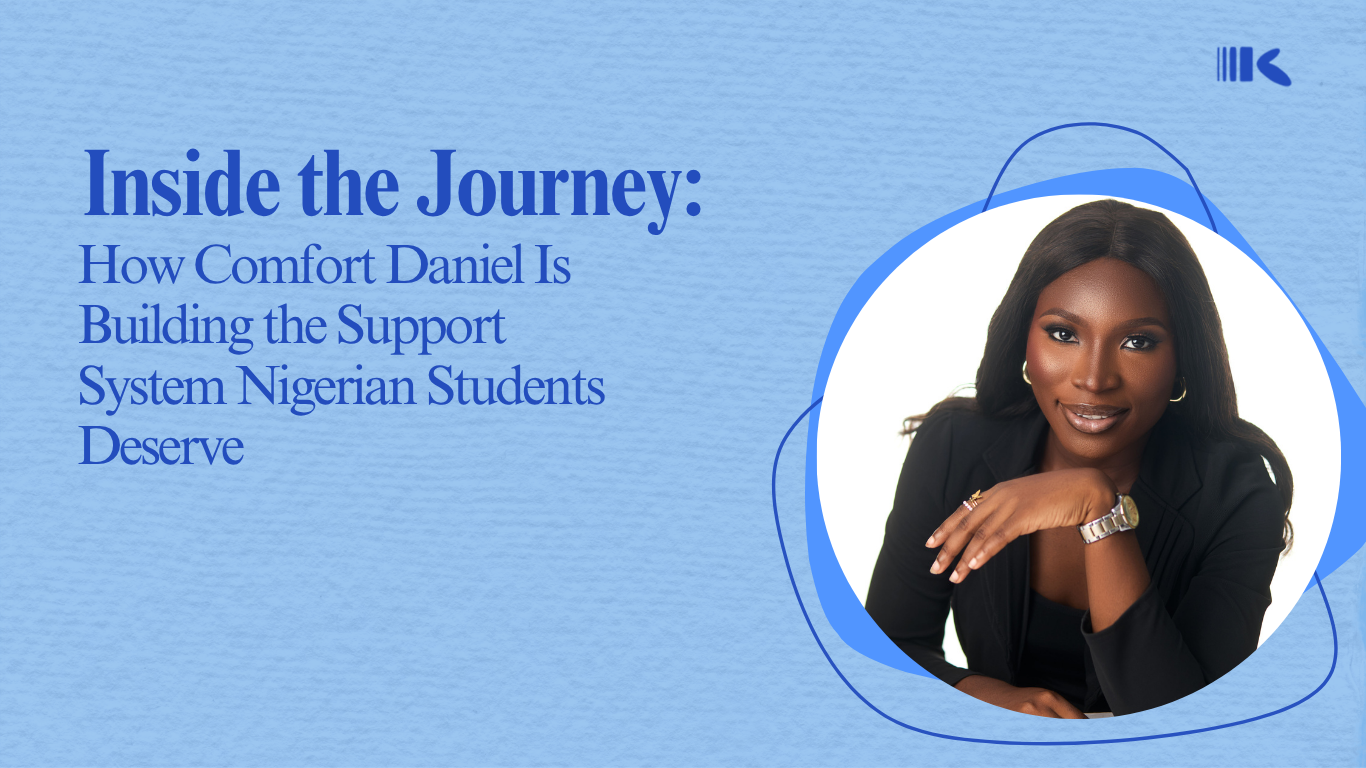

Inside the Journey is a Kryvent interview series documenting the stories behind the work. We speak with nonprofit founders and social entrepreneurs across different causes and stages of building about the decisions they made, the challenges they faced, what changed their minds, and what they are still figuring out. Our goal is to help others learn from the journey, not just the outcome.
Today, we are inside the journey of Comfort Daniel, a psychologist, mental health advocate, and founder of PAGE Africa, who is building a support system for young Nigerians that meets them where they are. Through its Student Wellness Hub, Youth Hub, and Career Discourse Series, PAGE connects students, recent graduates, and young people who are not currently in education or employment with psychosocial support, peer learning, and professional development. Across 12 universities and over 700 young people, Comfort is doing this while navigating her own career in clinical psychology, sitting on nonprofit advisory boards, and contributing to policy conversations at some of the most consequential tables in the sector.
Hello, can we meet you?
Hello, my name is Comfort Daniel and I do many things. By profession and qualification, I am a psychologist and a mental health and education advocate. My faith is also central to who I am. Over the years I have had the privilege of working across mental health practice, advocacy, policy change, and research, and it has been a fulfilling journey across these sectors.
I have worked across a number of social development projects ranging from digital inclusion, child rights, to education. I am the founder and executive director of PAGE Africa Initiative. Currently I sit on advisory boards with some nonprofits, serve as a youth advocate with UNICEF Nigeria, and contribute to policy conversations at Chatham House and other organisations.
Digital inclusion, Youth development, Children, and Education sum up your interest areas. But for PAGE Africa, most people working in this space tend to focus on one area. Why did you choose to work at the intersection of Mental health, Education, and Employability, and what gap were you trying to fill when you started?
This question is very similar to one a member of our advisory board asked me when we first started talking. These intersections are gaps I saw from being an undergraduate and they did not all come at once.
While I was in school, I started thinking about education first, from my interactions with students and sitting on panels sharing tips and information on opportunities. So the work started out as democratising access to opportunities. During my undergraduate years I also conducted research on “Academic Buoyancy and Psychosocial Support.” From that research, I realised that supporting young people mentally and psychosocially is important for helping them overcome various adversities during their academic journey and when building a career path. Young people are clearer on their goals and who they are as individuals when that support is in place, without sacrificing their wellbeing. There are a number of stressors, fears, and questions that come with being a student, a graduate fresh out of university, and that shapes people personally and professionally.
So I found that these three things work hand in hand. We need to integrate mental health into educational frameworks the way it is done in some other countries, with functioning and well-equipped counselling centres and strong support systems within faculties. A 2024 United Nations report found that students in Sub-Saharan Africa struggle with mental resilience, which reinforced what I was already seeing. After I graduated, I realised it was time to stop talking about the problems and put effort into solving them, by providing the kind of support system young people needed to thrive academically and professionally.
Your background is in psychology and research shaped how PAGE was built from the start. How has that training followed you into how you lead the organisation and make day-to-day decisions?
Can I just say that being a psychologist in Nigeria makes you one of the most creative people in the room. Starting with building: my training makes me research before I start anything, and I genuinely enjoy that process. When we started our programmes, I sat through calls with different kinds of people, especially students. Qualitative research, because most people do not respond well to surveys. During that process, I noticed young people struggle a lot during the gap year between secondary school and university. Some were also regretful about not maximising opportunities during their undergraduate years. We noticed common sentiments across certain groups.
In leading, I take an empathetic approach. The truth is, we work mostly with very little resources, so you have to rely on volunteers a lot. That makes me very empathetic about their time, their commitment, and being a support system for them in return. I have had volunteers reach out to me saying they want to have a session. These are sessions that others pay for, but I offer them to my team. It is my way of supporting the people who support the work. Leading them also makes me very protective of them when they are going through difficult moments or dealing with their own personal and academic challenges.
Decision making for me is always people-centred, and I try to instill that across the entire team. I encourage our programmes and communications teams to prioritise community engagement and to think from the perspective of the people we serve. “What speaks to them?” “What kind of support do they need?” “If you were standing in front of a group of young people right now, what would you say first?” That question guides how we hire, how we build our team, and how we design our programmes. Everything comes back to one question: what can help this person?
You spoke about empathetic leadership. But nonprofit leaders often walk a difficult line between empathy and the reality of unresponsive or uncommitted volunteers. How have you navigated that at PAGE?
This is something I had to work on when PAGE transitioned from a digital community to a nonprofit. From research, I gathered that an entirely volunteer workforce is not sustainable in the long run. So in the present, I had to put certain policies in place.
One of those policies is that every month, team leaders have a 15 minute check-in with every volunteer. I check in with leaders for 30 minutes. We also require at least a six month commitment to be part of the vision, and one year for leaders. When we are recruiting, interviews are not overly formal. I am listening for what you are saying but also for what you are not saying, to understand what your commitment is really like. So even when someone says they want to be part of the vision, you have to think carefully about what they have told you about their life. If they are a student, volunteering elsewhere, and managing other responsibilities, you love that they believe in what we are doing, but it is clear they do not have the capacity right now. We point them to our social media and our programmes instead.
I have also learned from psychology that some people do not know how to let go of something. You are the one who has to help them. They genuinely want to be part of the vision but we can see they do not have the capacity or time to give to it. So you say to them, you can contribute in another way. Follow us, join our programmes, but you do not need to be a core member of the team right now. You have to help some people leave, and that is not a failure on either side.
We also have a leave policy. Volunteers must inform us at least two weeks in advance. We have a volunteer coordinator who manages unresponsive volunteers, and a clear process for what happens when someone has not been in contact for a certain number of days. If after two weeks all attempts to reach them have failed, we let them go. We eventually traced most of these issues back to hiring. We no longer post volunteer calls on social media. We use platforms like Idealist, ask more considered questions during shortlisting, and use the interview to understand commitment levels carefully. Every volunteer also reads a handbook and signs a document outlining what is expected.
What part of the work has been the hardest to build?
I would say it is operational infrastructure. A lot of founders might say volunteer management or funding, and I understand why. But as we approach the third year mark in September, I have realised that if your structure is not strong enough, when certain opportunities or pressures come, you will not be able to manage them.
Last year, we had opportunities come our way that we could not take advantage of. We were missing application deadlines, doing too many things at once, and getting stuck. We are still facing some of those constraints. I have come to realise that as a leader you need people you can trust, pour yourself into, and know will get things done effectively. I do not want PAGE’s operations to be founder-dependent.
Lately, I have been looking at ways to transfer what I am learning to the team. One of our board members sponsored my place on the Lagos Business School Nonprofit Leadership Management programme, and one of the first things I did after just two days in class was build an organisational calendar for training. I committed to teaching the team everything I was learning.
Building these structures also meant asking myself: how do we ensure that our process does not break when I am not in the room? I created SOPs (Standard Operation Procedures) for all the teams at PAGE Africa and a master SOP to sit above them. I had always heard about SOPs in previous organisations I had worked in, but it was only when I looked at our impact reports and realised we had no record of what happened month to month, that I then understood why structure mattered. We had just not built the system to capture it.
One of our board members asked me if PAGE Africa is built to scale. It was a question that stopped me. He told me to write a five-year plan for the organisation, and when I sat down to do that, I began to realise that some things would have to be scrapped, that some of what we were doing was not connected to our goals at all. That was when I started to learn the difference between impact and output. I take monitoring and evaluation seriously now. We are taking stock of everything and iterating.
This has been the hardest part because I do not want PAGE to fail when I am not there. I am currently conducting research for my Masters, carrying out board duties elsewhere, and doing other advocacy work. But the more I build these structures, the more I can see the reward. I am no longer at the forefront of certain things. Team members now represent PAGE in spaces I would previously have had to be in myself. We have made real progress on operations and we are still learning.
You are building PAGE Africa while managing your Masters research, board responsibilities, and other advocacy work. How do you protect your own mental and emotional wellbeing in the middle of all of that, and what pitfalls do you think other founders should pay closer attention to?
The first pitfall to avoid is not recognising that you are yourself before you are the organisation. Do not build the organisation around yourself. People get emotionally drained when everything about the organisation is centred on them personally.
Let your team members define the vision in their own words. It builds ownership. In our organisation-wide meetings, which happen quarterly and are separate from our leaders meetings, I ask everyone what they currently understand about the vision. They also get updated on what is happening across different teams and what everyone is working on. Let them build their own sense of the vision within the larger one. When people take ownership, it reduces your mental load as a founder. You are no longer the only one thinking or strategising. Let them try different roles if they want to, and pay attention to where their strengths show up naturally.
Schedule time for yourself. I also take leave. Sometimes I do not take my hands off completely because we are a small organisation, but I go quiet for the duration and communicate only with the Operations Lead. They give me feedback where necessary or flag anything that needs my input. Most of the time they make decisions on their own because they are empowered to. Sometimes they worry about not approaching something the way I would. But I leave room for mistakes because that is how learning happens. And when I give feedback, I do not frame it as Comfort being displeased. I say PAGE Africa is not happy with this. That choice of words places the focus on the organisation rather than on me personally.
Team members do not contact me on my personal line about work issues. Everything goes to the group chat or by email, and not everything escalates to me. They reach out to the person in charge of operations first. Where someone previously might have contacted me directly about exiting the team, there is now a process that involves the Operations Lead.
Where do you see PAGE going in the near future, and what version of it will you be most proud of?
I see PAGE being a guide. Holding the hands of young people and walking with them through the journey of life. A big brother or big sister they can hold on to. But beyond that, I see us building a psychosocial infrastructure for students. By 2030, we must have impacted, not just reached, 10,000 young people.
This August we are taking a significant step toward that with the launch of the R3 Lab, the Resilience and Readiness Residency. It is a hybrid programme that combines psychological resilience training with hands-on career readiness, giving participants practical toolkits and portfolio-building skills to help them transition confidently into professional environments. It is the most intensive thing we have built so far and it represents the direction we are heading.
That kind of ambition requires us to have raised significant funds. The good thing is that we are registered as a Company Limited by Guarantee, so we will be embarking on a number of ventures soon, alongside pursuing grants. The vision is to create psychosocial safety through hubs across campuses, and to influence policies that integrate mental health into our educational frameworks.
What advice would you give a young founder who wants to build a nonprofit that solves a problem they have observed?
The first thing is to be very open to learning. It is one thing to have passion. It is one thing to build for scale. It is one thing to build for impact. And it is another thing entirely to build only for visibility. Know yourself and know your work.
Test and pilot your solution before adopting it at scale. If others have gone ahead of you in this space, ask them questions. If you are working in Nigeria, understand the policies that need to change to address the problem itself. A founder of a well-known nonprofit once told me that a foundation must work to put itself out of need. That has stayed with me.
Have a growth curriculum for yourself while you are building. Every year I set a goal for what I want to learn for PAGE Africa, separated from my personal goals. PAGE came to me in 2021 and I did not start building until 2023. Do not be in a hurry.
Be flexible and allow your vision to change. The world itself is changing, and it is not only funding that is volatile in this sector. You have to pay attention to how your work needs to adapt.
Start with the resources you have. There are things I wish I could do through PAGE almost immediately, like offer scholarships. But I know that will take time, and that is fine.
Do not rush to register every idea. The founder of SheCode Africa once told me that if you stay with a vision for at least two years, you will know whether you have the capability and the will to build it. Before you register and take on the financial cost, sit with it through the highs and lows first.
Reach out to people, especially through communities designed for that kind of connection. Do not hesitate to ask for help. I find that in communities like Bloom, people are genuinely willing to share knowledge, particularly those working in other regions. Communities that do not gatekeep information are invaluable. Partner with counterparts, and be open to volunteers from other parts of the world. One of our most outstanding volunteers at PAGE lives nine hours away in terms of time difference and still shows up for every meeting and does excellent work.
Invest in relationships. This sector runs on them. Jobs, nominations, and fellowships all move through relationships. Some opportunities never leave the circle they were created in.
Finally, you do not have to build it yourself. There are organisations with people building meaningful work from the inside. Blessing Abeng was not always a co-founder at Ingressive for Good from the beginning. Seeing the problem clearly and taking ownership made the difference. Somachi went into Tony Elumelu Foundation with a passion for entrepreneurship and became CEO. If there is an organisation already building the solution, join it and take ownership from within.
What becomes clear from this conversation is that the most dangerous gap in Nigerian education is not the one between students and opportunities. It is the one between students and the support they need to pursue those opportunities at all. Comfort Daniel is building into that gap with research, structure, and a level of intentionality that most organisations take years to develop.
Many thanks to Comfort Daniel for this conversation.
Do you love this content or have any feedback for us? Leave a comment below.