
Inside the Journey is a Kryvent interview series documenting the stories behind the work. We speak with nonprofit founders and social entrepreneurs across different causes and stages of building about the decisions they made, the challenges they faced, what changed their minds, and what they are still figuring out. Our goal is to help others learn from the journey, not just the outcome.
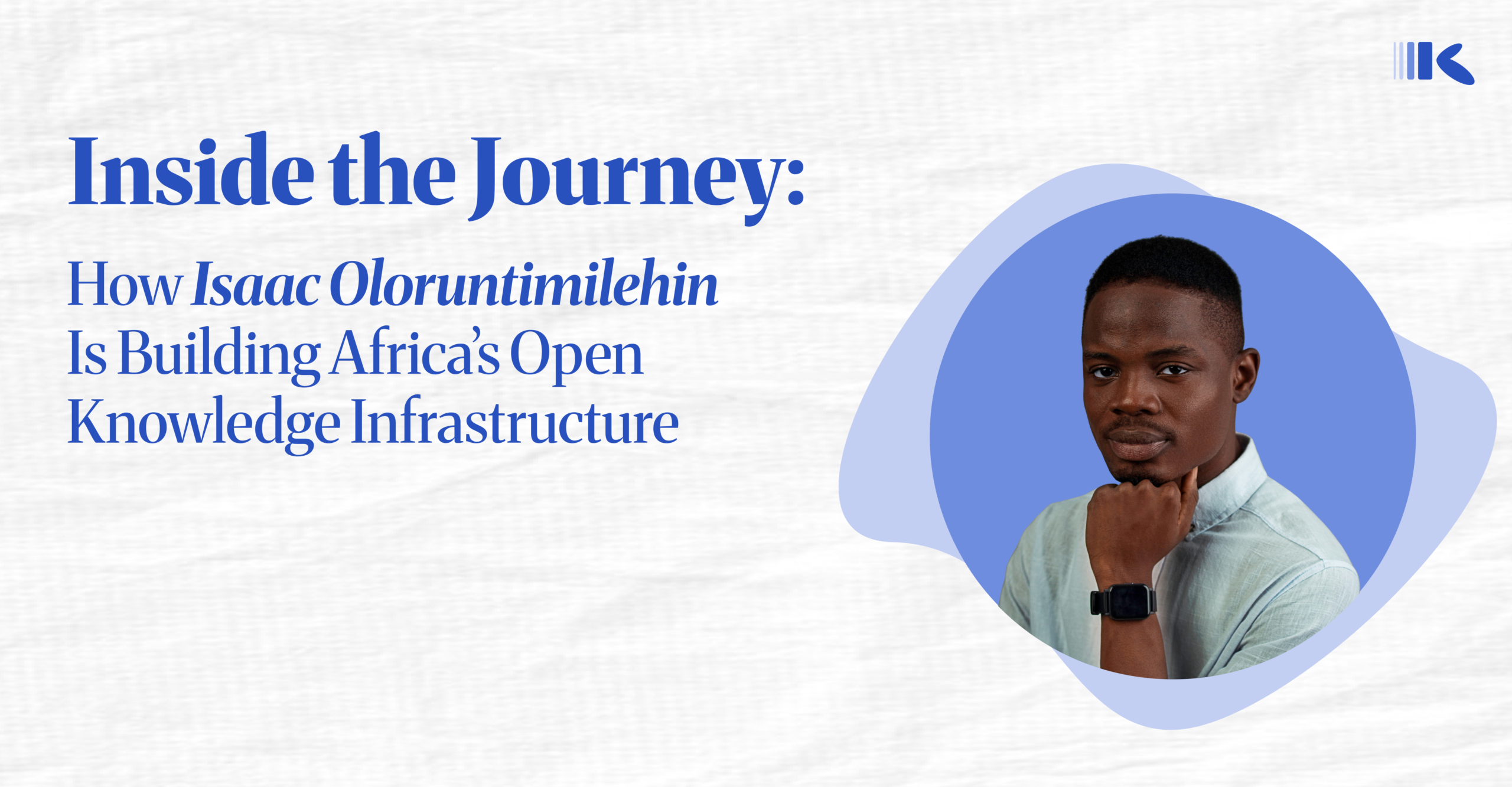
Today, we are inside the journey of Isaac Oloruntimilehin, co-founder of Free Knowledge Africa and a lifelong knowledge enthusiast whose path runs through Wikimedia clubs, national community work, and a Master’s in Global Development. What started as community involvement in the world’s largest open knowledge movement eventually became something Isaac built for his context, an organisation working to bring African history out of the libraries, archives, and museums where it has quietly sat unseen, and into the hands of anyone with an internet connection.
Hello, can we meet you?
Hello, my name is Isaac Oloruntimilehin. I am the co-founder of Free Knowledge Africa, which we started about five years ago, and I have been passionate about knowledge all my life. I was one of those kids always playing Encarta on the computer, reading Wikipedia, dictionaries, and books that had no relevance to what I was actually studying, both in secondary school and at the University. I read a lot, I study a lot, and I enjoy learning new concepts and things about different cultures and countries. I feel like there is so much knowledge in the world that I can only ever take in a small part of it, and that is also part of the reason I started Free Knowledge Africa with friends from university. We wanted to make knowledge accessible, preserve it, and document it, specifically African knowledge, or knowledge that relates to Africa and its people.
Your profile mentions you served as President of the Wikimedia Fan Club at the University of Ilorin, a club that did not exist at most other Nigerian universities at the time. Tell us about that journey, from how the club came to exist in Nigeria to your own time leading it.
So I actually did not start the club. Let me go back a little.
Wikipedia as a community started in 2001, founded by Jimmy Wales. Everything on Wikipedia is written by volunteer editors all over the world, so there is a community side to it. The Wikimedia Foundation hosts the infrastructure, the websites, and the technology that powers Wikipedia and about sixteen sister projects, including Wikidata, Wikisource, and several other wikis, all part of the same knowledge ecosystem.
In Nigeria, the Wikimedia Community User Group was established around 2015, and the first president of the club, Daniel Obiokeke, was part of that Nigerian community before they launched the club at the University of Ilorin in 2018. He was the first president, followed by Alaafiabami Oladipupo (Free Knowledge Africa’s Co-founder) as the second, and then I became the third. I was president for about two years, partly because of the COVID-19 pandemic. We were a community of students contributing to Wikipedia, and there were contests, prizes, and swags along the way, but at the core it was just people gathering to contribute to knowledge. We also received some funding from the Wikimedia Foundation to support our activities. There were similar clubs at other universities, including Lagos State University and Ekiti State University, though I am not sure how active they still are today. It was that same idea, bringing together people who cared about knowledge, that eventually led to Free Knowledge Africa.
You were already contributing to Wikipedia’s open knowledge movement and the club. How did starting Free Knowledge Africa come about and why?
While we were in school, we tried to create articles on Wikipedia about certain content, and they kept getting deleted or rejected by admins because we did not have relevant secondary sources to prove that what we were putting out was true and verifiable, even if they were culturally or historically correct. That situation led me toward Free Knowledge Africa.
Outside of that, Wikipedia itself started because two people had an idea to make knowledge free, and everyone now understands the value of that because information is made available, free, and open licence to use however you want. We thought about our own region and how information is preserved and shared here. I grew up in a context where oral tradition was still a primary way of preserving and passing down information, and if you compare development in Africa to other regions, that is part of the problem. You cannot write a thesis and cite your grandfather as the source. Nobody will accept that unless it is documented in audiovisual or text format, and a lot of historical information simply does not exist in either of those formats. The information that does exist often sits in libraries, archives, or media stations, and by the time you try to access it, you start to wonder why you are even bothering.
But the main reason we started was that Wikipedia required verifiable information with secondary sources. So we began documenting old newspapers from the (1920s -1950s), and I think that is more of what we are doing now. Now our focus has broadened to digitizing and preserving knowledge from cultural heritage institutions and libraries, materials the government should have digitized already but hasn’t, due to budget constraints. Our goal is to make this knowledge accessible, preserve it, and push institutions to digitize their own collections.
You have held leadership and research roles at development institutions including the Norwich Institute for Sustainable Development and the UN Sustainable Development Solutions Network. Setting those aside, along with your first degree in Urban and Regional Planning, how specifically has your Master’s in Global Development at the University of East Anglia shaped how you built Free Knowledge Africa?
Every experience has played an important part in my journey. My Master’s in particular gave me real insight into the development sector and how to understand context. I remember the first course we did, called Development Perspectives. It asked a simple question: what does development actually mean? People have very different notions of what development is, and it was an intense and genuinely interesting course.
My Master’s has been helpful in building my research skills, understanding what development means in different contexts, cultural sensitivity, and ethics in data collection. It also taught me how to manage projects through context review and evidence review before acting, rather than assuming. There was one course in particular that drove home the point that context is everything. Without it, we are lost and cannot really make sense of a situation. There is a well-known quote about how “There are known knowns, known unknowns, and unknown unknowns, the things we do not even know that we do not know.”
My time as a research assistant at the Norwich Institute for Sustainable Development was also valuable, particularly in learning how to identify under-researched causes where there is a real gap in evidence. That was the focus of my internship, looking specifically at food security in Africa. All of these experiences have shaped me in different ways. As for studying Urban and Regional Planning, that came naturally to me. I have always been drawn to geography, places, people, and cities.
My perspective is that I still need to learn more, especially running a nonprofit, where you never have enough resources and you depend heavily on volunteers. You are constantly talking about mission and vision, trying to get people committed to the work, and trying to show the value of what you are building. Learning and evolving as a person and as a leader is a continuous process, especially when it comes to relationship and communication skills. It never really ends, but my Master’s gave me a strong foundation because it was so focused on the development sector itself.
What has been the hardest part of building Free Knowledge Africa?
The hardest part of building anything, even a company, is getting people to see the vision and carry it the way you do, or even better. I think that has been the hardest part. There have been people who came in and carried the work so well that I found myself surprised. I would think, wait, you actually care about this thing that much? Even though they are not the founder or a team leader, they take it on as their own and see it as something genuinely important, and they show up ready to play their part.
Getting people to that point takes a lot of talking. This is what we want to do. This is why we want to do it. This is why it matters. It is powerful, it is transformational. Imagine every library having online access where people could interact with their resources directly. Research in Nigeria could be so much easier if more of these resources were available online.
For me, I think about this work every day. On a Sunday, a Monday, Public holidays, I am always thinking about what we could do next, whether we should apply for a grant or send out a proposal. It has become a habit at this point. But not everyone operates that way, and people have real constraints in their lives. Understanding that, and not being unreasonable about it, is also important. Maintaining that balance is part of the work.
The second hardest thing has been finding a structure that actually works. Should it be flexible or more freelance in style? Weekly meetings or midweek check-ins? It has been a continuous process of experimenting, whether that is choosing between WhatsApp, Google Chat, or Slack, or figuring out what kind of rhythm suits the team. Letting people do what they are naturally good at and find ease with has made a real difference, because when something feels personally easy, people show up for it more consistently.
I will say this though, the team at Free Knowledge Africa has been wonderful in how they show up. When feedback is given, in both directions, upward and downward, it is genuinely received and acted on.
The same trust and communication it takes to get work done internally. How have you navigated that with Galleries, Libraries, Archives, and Museums (GLAM) and their internal processes?
I am learning that relationships are powerful. There was a time we took a trip to Plateau State for a week. We flew from Lagos to Abuja, then travelled down through Kaduna to Plateau State, thinking we were going to change everything. We met a lot of people, but I would say we did not achieve much on that trip, even though we spent a fair amount getting there. We gained new experiences, a new culture, and exposure to a different part of Nigeria, but we did not get much in terms of actual outcomes with the institutions we hoped to work with.
We went to Plateau for its rich history, diversity, and mining heritage, aiming to document colonial-era material through local libraries, but it didn’t work out as hoped.
We have since evolved into building relationships one institution and one person at a time. From the National Library in Abuja to the Ilorin Library, and an ongoing engagement with the Institute of Advanced Legal Studies at the University of Lagos, these institutions have become great resources for us. One of the professors at the Institute is actually on our board now, and that has been genuinely helpful. With the National Library, we were able to build trust because one of our team member’s mom happened to be friends with the librarian there. We didn’t even know that until the introduction was made.
It is a general reminder to build good relationships with everyone you come across, neighbours included, because you truly do not know how your paths might connect later. These institutions need to trust you before anything else, and you need to be honest, direct, and a person of integrity with them, so there is never a sense that you are saying one thing while working toward something else. These institutions do not always trust young people easily. There can be a real mistrust, a fear that young people might do something that jeopardises their work or their collections.
So we keep building relationships one at a time. With the World Intellectual Property Organization (WIPO), for example, we invited them to an event we hosted in Abuja last October to share their perspective. We go to institutions, share what we are trying to do, and they tell us what is and isn’t possible from their side. If we list ten things we hope to do together, maybe only two are of interest to them, and that is fine. We focus on those two and figure out how to work with what is actually possible. It has been a continuous process of appreciating and honouring people, wherever and however we can.
Free Knowledge Africa collaborates with Wikimedia and Creative Commons. What does that relationship actually look like?
We are still Wikimedians, even though we are running Free Knowledge Africa, and we continue to contribute to Wikipedia, Wikimedia Commons, and Wikisource. We have digitised over 5,000 newspaper copies from the 1930s-1960s, and all of that work lives on Wikimedia Commons and PublicDomain.ng. Wikimedia is our most important strategic and financial partner. They provide funding to us, but I would not describe it as an incubation relationship. It is more of a community. We are advancing Wikimedia’s mission in our own way, through digitising and preserving African knowledge, while they support us from time to time, and we contribute to their activities in return.
Creative Commons works differently. They create open licences, the kind that allow knowledge to be released more freely instead of sitting under traditional copyright. They do a lot of advocacy work, and we contribute to their community activities periodically. They have also supported some of our events through funding. So with both Wikimedia and Creative Commons, the relationship is largely strategic and financial.
They play an important role in our work, but it is not day-to-day advice. It is more periodic, sometimes a check-in every six months or once a year. There is also a lot of learning that happens through conferences. Wikimania is coming up soon in Paris, and one of our team members will be attending. I attended two conferences in 2023 and 2024, one in Uruguay focused on GLAM, that is galleries, libraries, archives, and museums, and another in Chile on public policy advocacy. These conferences are where we gather with other organisations and Wikimedians in the open knowledge space to learn and exchange ideas.
What does the version of Free Knowledge Africa’s work that you will be most proud of actually look like?
The journey ahead of us is still long, and our mission is genuinely big. We are currently active in Nigeria, but we also run activities in Uganda, Tanzania, Ghana, and Benin Republic, including contests with participants from those countries, and an open educational resource training for teachers and educators last year.
Ultimately, the dream is that everyone has access to a library in their community. Access to quality education should be a fundamental human right, and our goal is for knowledge to be freely available and accessible to everyone. Libraries should function as community hubs, a place you can go even if you cannot afford a workspace elsewhere. If you have a membership card with your community library, you should be able to go there, work, use the internet, and print, the way a library is actually meant to function. It should hold resources and books, both physical and digital.
We want to see more of that, knowledge that is freely available across private institutions, public institutions, and research bodies, and a real shift in how people see libraries. Not just as storage for books or research, but as institutions for disseminating knowledge. Because what is the point of creating knowledge if nobody uses or has access to it?
If you were looking for something that happened in 1942 about malaria, for instance, I genuinely do not know how easily you would find that information today. You might, after a lot of effort, or you might not find it at all. We want a future where that kind of search is simple, whether it is data, audiovisual material, or archival footage like what the Nigerian Television Authority holds from moments such as Independence Day in 1960. We want a time when these things are easily accessible.
Many libraries and institutions exist in Nigeria, but not many function optimally. We want to be an enablement layer for these institutions as they digitise, and for others who want to build libraries or knowledge-sharing communities of their own. There is also a real gap when it comes to libraries for persons living with disabilities, and that is something we want to help address. Ultimately we want knowledge to reach everyone, not just the people who already have access through universities and polytechnics, but real knowledge, the kind that genuinely transforms and empowers people.
You have spent years building toward knowledge that genuinely transforms and empowers people, often with very limited resources and institutions that were not always quick to trust you. What would you want a young person trying to build something similar to hold onto, especially in the early days?
I would say this is very hard work, much harder than you may imagine or expect. Your assumptions will be tested, and some of them may even shatter completely, depending on how ambitious the idea is. I say this because I have been doing this for over five years now, and it remains something I feel deeply passionate and concerned about.
You also need to know that people will not always care. You will believe the work is important, but when you speak to some people, they will simply say it is not their concern. You have to understand that this is normal. People will question you, your friends will question you, and your family may not fully understand what you are doing, especially if you are still young and living at home. There will be moments of doubt from the people around you, but you have to hold onto why you are doing it, and you need to find your own people.
Once you find people who are committed, or even more committed than you are, people who carry an ownership mindset rather than just showing up, everything becomes easier. You do not want to work with people who are not genuinely committed. It strains everyone involved, including the people who are committed, because uncertainty and complaint spread quickly in a small team. So find your own people, because this will be hard, and collaborate with others as much as you can. You do not need to do everything alone.
If you find an organisation doing similar work with similar values, collaborate with them and celebrate their work rather than competing with it. And do not build without thinking about income generation from the start. The funding landscape has become much harder in recent years, so if there is any way to tie value to revenue that can fund your operations, take it seriously. Without that, many things can go wrong.
I am sure you have heard people talk about spending their own personal money to keep their organisation running. I would not recommend that, and I do not think it is wrong if others choose to, but I would caution against putting yourself in a financially dire situation. The mission needs you to be okay, mentally and financially, in order to keep going.
Beyond that, keep growing. Keep learning about leadership, systems, structure, how to motivate people, and how to appreciate them too. Learn about finance and legal compliance. Some people set up nonprofits without understanding filing requirements or anti-money laundering measures, and that can put you in real legal trouble without you even realising it. Understand your responsibilities fully, because the last thing you want is for your organisation to unknowingly become a pipeline for criminal networks. Be prepared to keep learning, always.
Many thanks to Isaac Oloruntimilehin for this conversation.
If you found this insightful or have a guest recommendation, leave us a comment below.