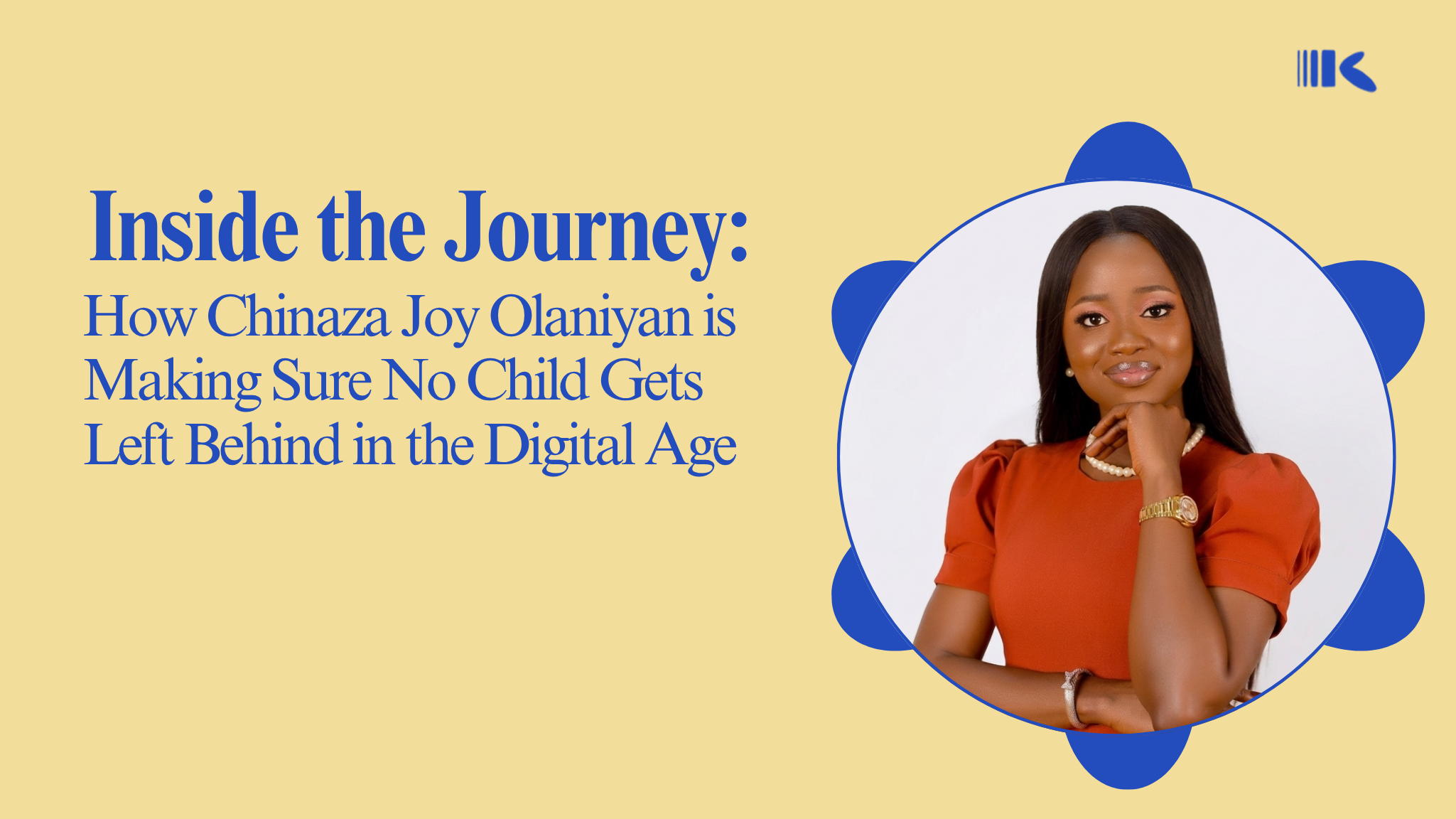

Inside the Journey is a Kryvent interview series documenting the stories behind the work. We speak with nonprofit founders and social entrepreneurs across different causes and stages of building about the decisions they made, the challenges they faced, what changed their minds, and what they are still figuring out. Our goal is to help others learn from the journey, not just the outcome.
Today, we are inside the journey of Chinaza Joy Olaniyan, Project Manager and Co-founder of Cybtracy Digital Literacy and Sustainability Initiative, popularly known as Cybtracy, a nonprofit helping children in underserved communities build digital and life skills for the future. Over the last six years, Cybtracy has trained more than 200 children, taking many of them from having never seen a computer to learning digital literacy, online safety, public speaking, sustainability education, and other skills that improve social mobility.
Hello, can we meet you?
Hi, my name is Chinaza Joy Olaniyan. I’m a Project Manager and Social Entrepreneur, and I have the privilege of being the Co-founder of Cybtracy Digital Literacy and Sustainability Initiative (Cybtracy), a tech-enabled nonprofit that is focused on promoting digital literacy in underserved communities across Lagos and Nigeria.
When you first started Cybtracy, what problem were you trying to solve, and how has your understanding of that problem changed over time?
When we started Cybtracy in 2020, our focus was on basic digital literacy and functional literacy, which is, literacy that can actually be applied in the real world. We understood that digital literacy is fundamental to functional literacy.
The idea came during my service year as a Youth Corps member when I realised I couldn’t use basic digital tools like PowerPoint. As I looked into it, I discovered that many others faced the same challenge. That was what inspired me to start teaching these skills to younger people, particularly secondary school students, because they were already skills their peers around the world were using every day.
As we’ve grown, our understanding of the problem has evolved. We’ve realised that soft skills are just as important as technical skills when it comes to social mobility. Many of the young people we serve are already at a disadvantage because of where they were born and the opportunities available to them. We want to bridge that gap.
Today, alongside digital literacy, we focus on public speaking, confidence-building, emotional intelligence, communication, and critical thinking, especially in a world increasingly shaped by AI. Our work has expanded because we’ve seen firsthand that technical skills alone are not enough.
Many organisations focus on access to technology. Cybtracy focuses on digital literacy. Why did you choose that angle, and what makes it important?
We focus on digital literacy because we believe it is a human right. In fact, that’s our slogan. The conversation is no longer just about “computer classes.” The world has changed, and digital literacy has become a core part of basic literacy. We live in a global village where people interact with technology every day, whether at school, at work, or in everyday life.
Access to devices is important, but access without knowledge doesn’t create meaningful change. Digital literacy equips children from underserved areas to participate fully in the world around them. It improves their opportunities, confidence, and ultimately quality of life. That’s why we see it as an essential part of functional literacy.
What is Cybtracy’s theory of change? In other words, what do you believe has to happen for the communities you serve to experience long-term transformation?
Cybtracy’s theory of change is that digital skills can improve social mobility. One way to ensure this happens is not just by focusing on the students, but also on their teachers. Through our surveys and research after five years of operations, we discovered that there is also a teaching crisis. We do not have sufficiently qualified and motivated teachers who are willing to stay in these underserved communities and impart this knowledge.
I believe that when we are able to address the teaching crisis, the communities we serve will experience long-term transformation because they will have people who are continuously and consistently available to impart and improve the knowledge of these students. As a result, the gap we are trying to close will be bridged to a reasonable extent, and we will see transformation in its true form. I believe that very strongly.
In simpler terms, if teachers are well-equipped and fairly compensated, just like their counterparts in urban areas, I believe they will be more willing to remain in these underserved communities and teach these children consistently and continuously until they become highly proficient in their skills. When that happens, we will see long-term transformation.
What are you currently grappling with the most as a non-profit founder?
That’s a very good question.
Honestly, one of our biggest challenges right now is talent—the people needed to help us scale our operations. With the right people, a lot becomes possible. It’s much easier to execute projects and grow an organisation when you have skilled, committed individuals working alongside you.
The second challenge is funding. as a non-profit organisation, we require significant financial resources to fund some of our projects and training outreaches. Accessing sustainable funding remains one of our biggest challenges as an organisation.
Cybtracy was built by co-founders. How have you and your co-founder divided responsibilities over the years, and has that division evolved as the organisation has grown?
Fortunately, this has been quite easy for us because we come from different professional backgrounds.
My background is in education and project management. I have an NCE, a Bachelor’s degree, and a Master’s degree in Education, so I handle the pedagogical and project management aspects of the organisation.
My Co-founder, Akanmu Ifeoluwa, comes from a technology background. She oversees our curriculum development, volunteer training, and other technical aspects of our work.
As the organisation has grown, our roles have evolved. We’ve become better at delegating responsibilities to volunteers and team members. Personally, I’ve increasingly stepped into the role of a full-time project manager, focusing more on systems, execution, and organisational growth.
Have there been moments when your personal ambitions and the needs of the organisation were in tension with each other? How did you navigate that?
If we’re speaking of personal ambitions, I’d say I’ve not actually had that conflict because I’ve always loved teaching and all that I currently do at the organisation. This is not just for saying it, but I actually love teaching and organising things, so I’m doing what I love and making an impact while at it.
I’ve always loved teaching and organising people and projects, so the work I do through Cybtracy aligns naturally with who I am. I’m doing something I genuinely enjoy while creating impact at the same time.
I remember meeting one of our students from our most recently completed teaching project in the market three weeks ago. Sadly, she was hawking, and she called me by name. I didn’t immediately remember her because we’ve worked with so many students, but she remembered me.
That moment stayed with me. It reminded me that the work we’re doing matters. I believe she won’t remain in that situation forever, and I believe the skills she’s learning today can help create a different future for her family and her.
Five years from now, what would need to be true for you to feel the organisation is moving in the right direction?
Five years from now, one of the biggest indicators of progress for me would be seeing a significant reduction in the teaching crisis within underserved communities.
I would love to see qualified teachers earning salaries that make them motivated to stay and consistently teach these skills to children. Not just a “computer teacher”, but being practical about teaching and applying basic digital literacy skills such that we’re seeing the impact in the lives of these children.
I would also love to see the students we’ve trained progressing into tertiary institutions and confidently applying both their technical and soft skills to navigate higher education and life beyond school.
I want to see students from the communities we trained writing computer-based examinations confidently and independently. I want to see young people who are no longer limited by a lack of digital exposure.
Ultimately, I’d like to see us bridge the digital divide to a meaningful extent and create opportunities that genuinely change lives.
What becomes clear from this conversation is that Cybtracy’s work extends beyond teaching children how to use technology. At its core is a belief that digital literacy, quality education, and the right support systems can expand opportunities and improve social mobility for young people in underserved communities. Six years in, the co-founders of Cybtracy continue to build, navigating the realities of funding and talent, while remaining committed to creating a lasting impact where it is needed the most.
Many thanks to Chinaza Joy Olaniyan for this conversation.
Do you love this content or have any feedback for us? Leave a comment below.